Signal Loss in Long-Distance Automation? How the Remote I/O Module Solves It
How Remote I/O Module Improves Signal Integrity in Automation
In modern industrial automation, plants are spread across larger areas than ever before. Whether it’s a manufacturing floor with multiple zones, a complex conveyor system, or a remote pumping station, signal integrity becomes critical. Long cable runs, electrical noise, and latency can all interfere with reliable data exchange between sensors, actuators, and the controller.
This challenge is where the remote I/O module shines, providing a smart and scalable solution that dramatically reduces signal loss, increases reliability, and simplifies system architecture.
In this blog, we’ll explore why signal loss happens in long-distance automation, how a remote I/O module solves it, and why companies trust Avyana Tech’s solutions for robust performance.
Why Signal Loss Happens in Long-Distance Automation
Before we discuss the solution, it’s important to understand the problem. Long cable runs and distributed equipment can cause:
1. Voltage Drop
When electrical signals travel over long conductors, resistance causes voltage to drop. Sensors and actuators farther from the controller may receive weaker signals, leading to missed triggers or incorrect readings.
2. Electrical Noise & Interference
Industrial environments are full of motors, welders, pumps, and variable frequency drives (VFDs). These generate electromagnetic interference (EMI) that can corrupt sensor signals during transmission.
3. Latency & Timing Errors
Long distances introduce delays. When a controller continuously polls distant I/O points, this can increase system cycle time and impact real-time control.
4. High Wiring Costs
Connecting every I/O point individually to the main controller needs extensive cabling and junction boxes, increasing installation time and costs.
All of these issues can contribute to signal loss and unreliable automation performance, unless the system architecture is optimized.
What Is a Remote I/O Module?
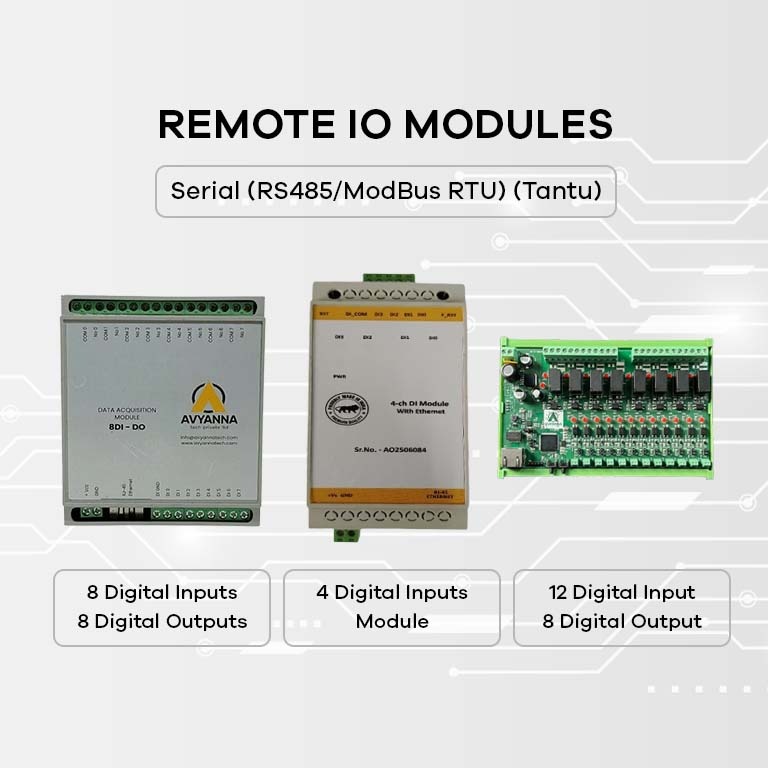
A remote I/O module is a distributed interface unit that sits close to sensors and actuators and communicates digital and analog signals back to the main controller (PLC/RTU/Industrial PC) via a fast communication bus rather than traditional direct wiring.
This small unit acts as a bridge between the field signals and the central controller, allowing you to:
- Collect data from remote sensors
- Control field devices (valves, relays, motors)
- Reduce wiring complexity
- Maintain signal integrity over long distances
A remote I/O module lets you use shorter local wiring around field devices and a single robust communication network (such as Ethernet/IP, Modbus TCP, ProfiNet, etc.) to carry data back to your control room.
How the Remote I/O Module Solves Signal Loss
Here’s how a remote I/O module effectively tackles the challenges listed above:
1. Short Field Wiring
Instead of running 100s of meters of individual copper wires to the controller, the input output module is installed close to sensors and actuators. This drastically reduces the chance of voltage drop and electrical noise affecting signals.
2. Robust Digital Communication
Communication between the remote I/O module and controller is done via digital protocols designed for long distances. Technologies like Modbus, Ethernet/IP, ProfiNet, and EtherCAT are less susceptible to interference compared to parallel copper wiring.
3. Reduced EMI Impact
With shorter wiring and shielded communication lines, the system is far less affected by electrical noise from heavy machinery. This preserves the integrity of both digital and analog data.
4. Synchronized Data
Modern remote I/O modules support high-speed scanning and synchronized data exchange. This means real-time control and faster response times, even when devices are physically distant.
5. Simple Scalability
Need to expand your plant? Adding more input output modules is easier than running new long wiring back to the PLC. Plug-and-play expansion keeps signal quality consistent across zones.
Real-World Example: Manufacturing Plant
Imagine a large factory where conveyor belts, robotic arms, and packaging units span multiple zones. Traditionally, each sensor (for position, speed, temperature, etc.) would require direct wiring to the controller.
Issues with traditional wiring:
- Long cables running through floors and ceilings
- Increased signal noise near motors
- Higher installation and maintenance costs
With a remote I/O module installed in each zone, all local sensors are wired nearby. These modules communicate back to the PLC through a high-speed network, eliminating long wiring runs and maintaining reliable signal integrity.
Key Features to Look For in a Remote I/O Module
When choosing a remote I/O solution, consider:
- Modularity: Expandable slots for adding more input/output points.
- Communication Protocol Support: Compatibility with your controller’s network (Ethernet/IP, Modbus, ProfiNet).
- Signal Types: Support for digital, analog, and specialty signals.
- Environmental Protection: IP-rated designs for harsh industrial conditions.
- Diagnostic Feedback: Built-in diagnostics to detect wiring faults or signal degradation.
All of these features help ensure that your remote I/O module performs reliably in challenging environments.
Why Avyana Tech for Remote I/O Solutions?
At Avyana Tech, we specialize in industrial automation solutions that improve system reliability and performance, especially where long distances and complex machinery are involved.
Our remote I/O modules and input output module solutions are engineered to:
- Minimize signal loss and interference
- Simplify wiring and reduce costs
- Improve system uptime
- Support real-time communication with modern PLCs
We work with your team to design, supply, and deploy the right remote I/O architecture that fits your application, from small installations to large-scale plants.
Conclusion
Signal loss doesn’t have to be a part of long-distance automation anymore. The right remote I/O module architecture not only preserves signal integrity but also simplifies installation, enhances reliability, and future-proofs your automation system.
Whether you’re expanding an existing plant or building a new automation line, remote I/O modules are a practical and powerful choice for modern control systems.
Ready to solve signal loss and optimize your automation? Reach out to us for expert remote I/O design and implementation.



[email protected]