
How to Choose the Right Modbus Gateway for Your Industrial Setup (1-Port vs 2-Port vs 4-Port Guide)
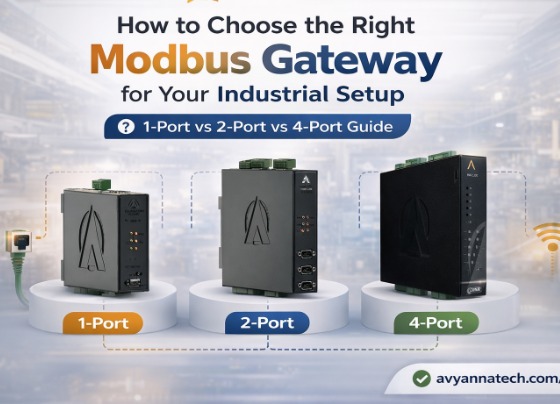
Industrial Gateway Server: 1 vs 2 vs 4 Port Guide
In today’s connected industrial environments, machines, sensors, and control systems must speak the same language. But in reality, they often don’t.
That’s where an industrial gateway server becomes critical.
If you’re working with legacy systems, PLCs, or serial-based devices, a Modbus gateway acts as the bridge, connecting traditional equipment with modern Ethernet-based networks.
But here’s the real question most engineers and decision-makers struggle with:
Should you choose a 1-port, 2-port, or 4-port Modbus gateway?
Let’s break it down in a simple, practical way, so you can choose the right solution for your setup without overpaying or underperforming.
What is an Industrial Gateway Server?
An industrial gateway server is a communication device that enables seamless data exchange between different industrial protocols and networks.
In the case of a Modbus gateway, it converts:
- Modbus RTU / ASCII (serial communication) into
- Modbus TCP/IP (Ethernet-based communication)
This allows:
- Real-time monitoring
- Centralized control
- Data logging and analytics
- Integration with SCADA, IoT, and cloud systems
Why Choosing the Right Port Configuration Matters
Not all industrial setups are the same.
The number of ports in your Modbus gateway determines:
- How many devices you can connect
- Your system’s scalability
- Wiring complexity
- Overall cost efficiency
Choosing the wrong one can lead to:
- Network congestion
- Limited expansion
- Unnecessary hardware costs
1-Port Modbus Gateway: Simple & Cost-Effective
Best for:
- Small-scale automation setups
- Single machine integration
- Basic monitoring systems
When to choose it:
If you have one serial device or a single communication line, a 1-port gateway is enough.
Benefits:
- Affordable
- Easy to install
- Minimal configuration
- Ideal for compact systems
Example Use Case:
A standalone industrial machine that needs to connect to a SCADA system.
If your setup is simple, don’t overcomplicate it.
2-Port Modbus Gateway: Balanced & Flexible
Best for:
- Medium-scale industrial setups
- Multiple PLCs or devices
- Systems requiring redundancy
When to choose it:
If you need to connect 2 separate serial networks or device groups, this is your sweet spot.
Benefits:
- Better load distribution
- Reduced communication delays
- Flexibility for expansion
- Cost vs performance balance
Example Use Case:
A production line with two different machine clusters operating independently.
This is the most commonly chosen configuration in growing industries.
4-Port Modbus Gateway: High-Performance & Scalable
Best for:
- Large industrial environments
- Complex automation systems
- Multi-line manufacturing plants
When to choose it:
If your setup involves multiple devices across different sections, or you plan to scale in the future.
Benefits:
- High device connectivity
- Efficient traffic management
- Scalable architecture
- Centralized communication
Example Use Case:
A factory with multiple production lines, each requiring real-time data exchange.
If you’re planning long-term growth, this is a future-proof choice.
Key Factors to Consider Before Choosing
Before finalizing your industrial gateway server, ask yourself:
1. How many devices need connectivity?
Count current devices + future expansion.
2. What is your network complexity?
Single line → 1-port
Multiple lines → 2 or 4-port
3. Do you need scalability?
If yes, avoid 1-port unless absolutely sure.
4. Data traffic load
More devices = more data = more ports needed.
5. Installation environment
Industrial-grade gateways (like Avyanna’s SETU Series) are designed for:
- Harsh environments
- Continuous operation
- Reliable performance
Why Avyanna Tech Modbus Gateways Stand Out
Avyanna Tech’s SETU Series is built specifically for industrial reliability and performance.
What you get:
✔ Seamless protocol conversion
✔ Stable, real-time communication
✔ Industrial-grade durability
✔ Multiple port configurations (1, 2, 4-port)
✔ Easy integration with existing systems
Whether you’re upgrading legacy systems or building a new automation setup, Avyanna’s solutions are designed to scale with your needs.
Conclusion
Choosing the right industrial gateway server isn’t about picking the most advanced option; it’s about choosing what fits your system today and tomorrow.
Quick Decision Guide:
- 1-Port → Small, simple setups
- 2-Port → Growing systems with moderate complexity
- 4-Port → Large-scale, future-ready industrial networks
Make the right choice, and your entire automation system becomes faster, smarter, and more efficient.




[email protected]