
5 Industrial Applications Where a Serial Device Server Makes Sense
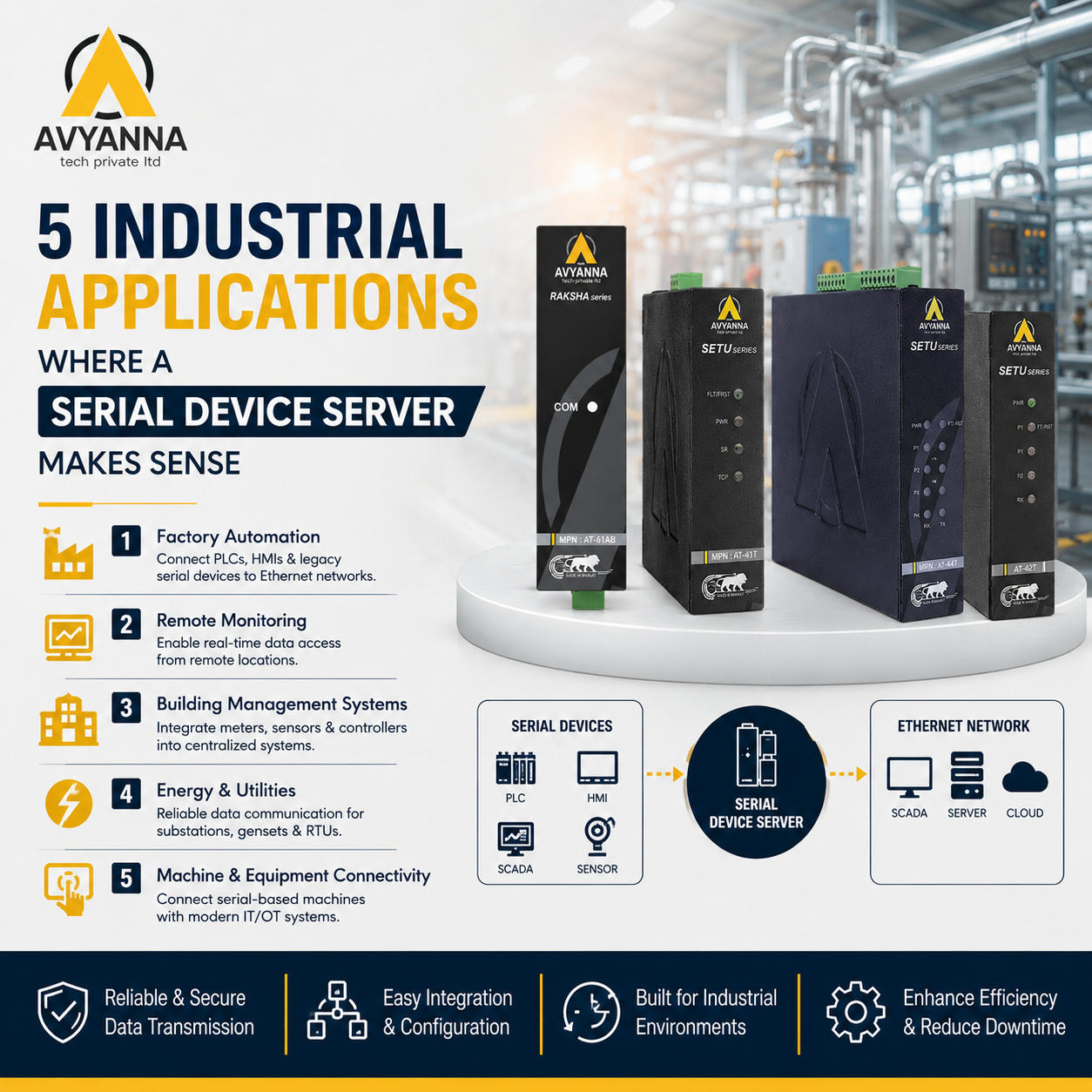
5 Applications for a Serial Device Server
A serial device server isn’t a niche piece of equipment reserved for unusual edge cases – it’s a practical fix for one of the most common problems in industrial facilities: equipment that only speaks RS-232, RS-422, or RS-485 needing to join a modern Ethernet-based network. Recognizing which applications benefit most from this bridge helps clarify whether it’s the right tool for a specific connectivity challenge, rather than treating it as a generic catch-all solution.
An industrial device server converts serial communication into Ethernet/TCP-IP traffic, allowing legacy equipment to be monitored, controlled, and integrated into SCADA, MES, or cloud platforms without requiring hardware replacement. Below are five specific industrial applications where this conversion consistently delivers clear, practical value.
Application 1: Connecting Legacy PLCs to Modern SCADA Systems
Many facilities run PLCs installed a decade or more ago that communicate only over RS-232 or RS-485, while the SCADA platform managing the rest of the facility expects Ethernet-based communication. A serial device server bridges this gap directly, allowing the legacy PLC’s data – production counts, alarm states, process variables – to flow into the SCADA system without reprogramming the PLC or replacing functioning control hardware.
Why it makes sense here: PLCs are often deeply embedded in validated processes, and replacing one solely for network connectivity is rarely justified when a serial device server accomplishes the same integration goal at a fraction of the cost.
Application 2: Remote Monitoring of Lab and Measurement Instruments
Laboratory and quality control instruments – spectrometers, scales, gauges, and similar measurement equipment – frequently use RS-232 for data output, often because the instrument itself is validated for regulatory compliance and hasn’t been (or can’t easily be) replaced. An industrial device server allows this equipment to be monitored remotely, with data automatically logged to a central database or quality management system instead of requiring manual transcription from a local display.
Why it makes sense here: Regulated instruments often can’t be swapped out without triggering costly recertification, making a serial device server one of the few practical ways to modernize data collection without disturbing the validated equipment itself.
Application 3: Centralizing Data from Distributed Building and Facility Systems
HVAC controllers, energy meters, and building automation equipment across a large facility or campus often communicate over RS-485, particularly in older installations. A serial device server – especially multi-port models – allows facilities teams to consolidate data from equipment spread across multiple buildings or floors into a single centralized monitoring dashboard, without running new communication cabling across the entire site.
Why it makes sense here: Retrofitting network cabling across an entire facility is expensive and disruptive; bridging existing serial infrastructure is significantly faster and less invasive.
Application 4: Enabling Remote Access to CNC and Machining Equipment
CNC machines and older automation cells often include serial ports for program transfer, diagnostics, or status monitoring, but lack native network connectivity. A serial device server allows machine operators and maintenance teams to access this equipment remotely – transferring programs, checking machine status, or troubleshooting – without needing to be physically present at the machine, which is particularly valuable across large manufacturing floors or multi-shift operations.
Why it makes sense here: CNC equipment represents significant capital investment with long depreciation cycles, making connectivity retrofits through a serial device server far more cost-effective than early replacement.
Application 5: Integrating Point-of-Sale and Barcode Systems into Inventory Networks
Retail and warehouse point-of-sale terminals, barcode scanners, and label printers frequently rely on RS-232 connections, especially in older installations. A serial device server allows this equipment to connect to a broader inventory management or ERP network, enabling real-time inventory updates and centralized transaction data without replacing functioning point-of-sale hardware.
Why it makes sense here: POS and barcode equipment is often reliable and well-understood by staff; a serial device server extends its usefulness into a networked environment without retraining staff on new hardware.
Common Thread Across These Applications
Each of these five applications shares the same underlying pattern: functional, often expensive or regulated equipment that only supports serial communication, sitting alongside a broader push toward networked, centralized data systems. A serial device server resolves the mismatch without forcing a choice between keeping reliable equipment and gaining modern connectivity – it enables both simultaneously.
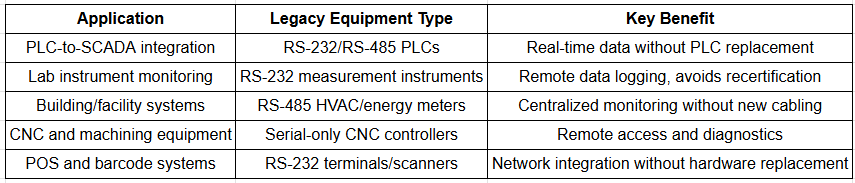
Industrial Applications for a Serial Device Server: Quick Reference
How to Evaluate If Your Application Needs a Serial Device Server
- Confirm the equipment’s communication interface: Verify whether it uses RS-232, RS-422, or RS-485, since this determines the specific converter/device server configuration needed.
- Identify the target network or platform: Determine whether the data needs to reach a SCADA system, cloud platform, or centralized database, which affects the operating mode (virtual COM port, TCP/UDP socket, or Modbus gateway) required.
- Assess the number of devices involved: A single legacy machine may only need a single-port device server, while a cluster of instruments or controllers in one area often benefits from a multi-port unit.
- Consider environmental conditions: Factory floor installations typically require industrial-grade device servers with DIN-rail mounting and extended operating temperature ranges, unlike office or lab-based deployments.
- Check existing software compatibility: If existing monitoring or control software must remain unchanged, prioritize a serial device server supporting virtual COM port mode.
Frequently Asked Questions
What industrial applications commonly use a serial device server?
Common applications include connecting legacy PLCs to SCADA systems, remote monitoring of lab and measurement instruments, centralizing data from building automation systems, enabling remote access to CNC machines, and integrating point-of-sale or barcode systems into inventory networks.
Can a serial device server connect equipment across multiple buildings?
Yes, particularly multi-port serial device servers, which can consolidate data from serial devices spread across a facility or campus into a single centralized network connection, avoiding the need to run new cabling to each location.
Why use a serial device server instead of replacing legacy equipment?
A serial device server allows functional legacy equipment – PLCs, lab instruments, CNC machines – to gain network connectivity without the cost, downtime, and in some cases, regulatory recertification, involved in replacing that equipment outright.
What is the difference between a serial device server and an industrial device server?
The terms are generally used interchangeably; “industrial device server” typically emphasizes that the unit is built with rugged, factory-floor-rated construction, while “serial device server” describes its core function of converting serial communication into Ethernet/TCP-IP traffic.
Do lab instruments need special consideration when using a serial device server?
Yes. Many lab and measurement instruments are validated for regulatory compliance, so any connectivity change should preserve the instrument’s original configuration and calibration. A serial device server typically doesn’t require modifying the instrument itself, making it a low-risk way to add remote monitoring capability.
Match the Application to the Right Connectivity Solution
These five applications share a common thread: valuable, functional equipment limited only by its lack of native network connectivity. A serial device server resolves that limitation directly, letting facilities modernize data access and remote monitoring without replacing hardware that still works exactly as intended.
At Avyanna Tech, we help facilities identify where a serial device server or industrial device server fits into their connectivity strategy, from single-machine bridges to multi-port, facility-wide deployments. Contact us to explore our full range of serial device server solutions and connect the equipment that’s been waiting to join your network.

[email protected]