RS232 vs RS485: Why You Need a Converter in Industrial Automation
RS232 to RS485 Converter: Why You Need a Converter
In modern industrial environments, seamless communication between machines is critical. From PLCs and SCADA systems to CNC machines and sensors, reliable data transfer ensures efficiency, safety, and productivity. However, one common challenge industries face is compatibility between different communication protocols, especially RS232 and RS485.
This is where a rs232 to rs485 converter becomes essential.
Understanding RS232 and RS485
What is RS232?
RS232 is one of the oldest and most widely used serial communication standards. It is commonly found in:
- Legacy industrial equipment
- Computers and control panels
- Point-to-point communication systems
Limitations of RS232:
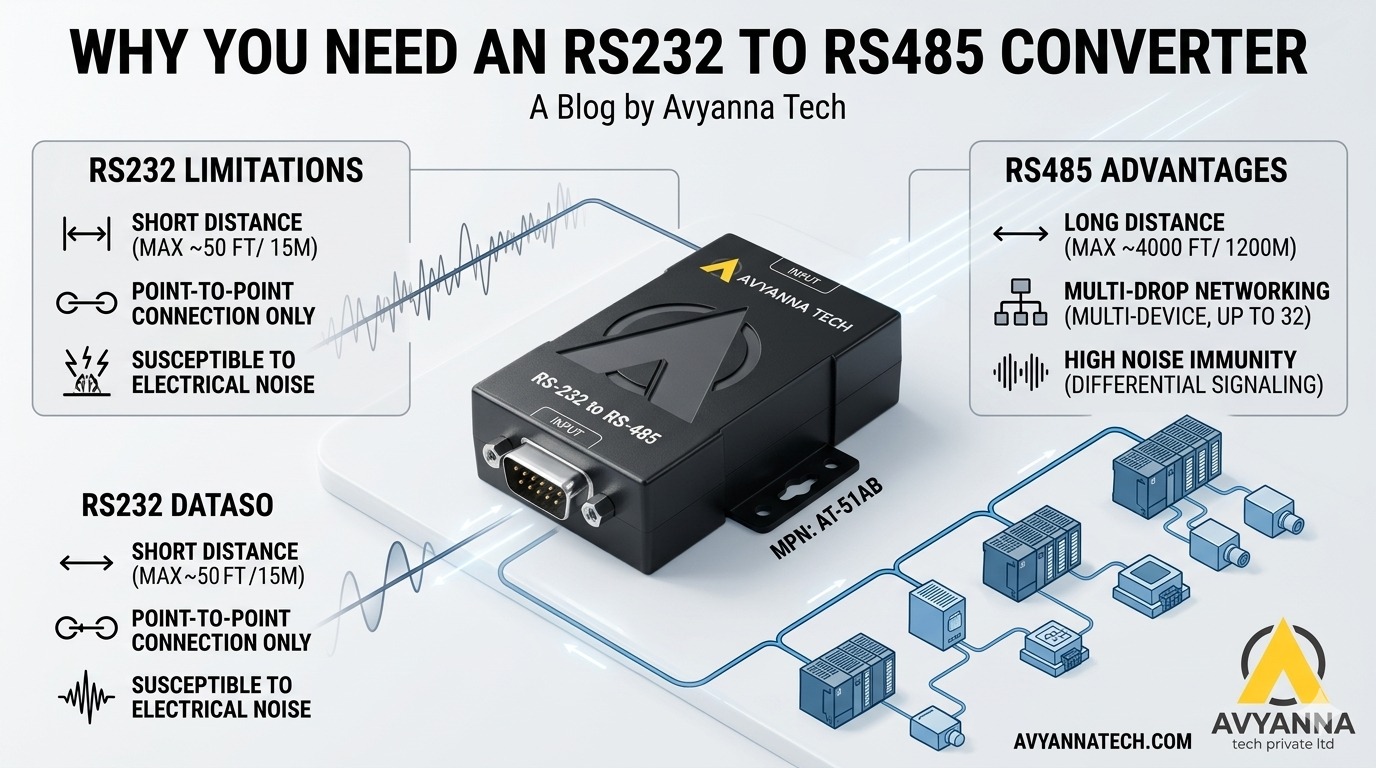
- Short communication distance (typically up to 15 meters)
- Supports only one-to-one communication
- More prone to signal noise in industrial environments
What is RS485?
RS485 is a more advanced communication standard designed for industrial applications.
Key advantages:
- Long-distance communication (up to 1200 meters)
- Supports multiple devices (multi-drop network)
- High resistance to electrical noise
- Ideal for harsh industrial environments
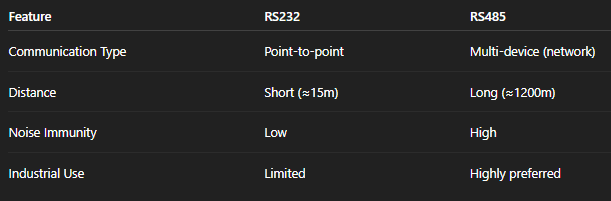
RS232 vs RS485: Key Differences
Why You Need an RS232 to RS485 Converter
In real-world industrial setups, many legacy systems still operate on RS232, while modern automation systems rely on RS485.
This creates a communication gap.
A rs232 to rs485 converter bridges this gap by enabling devices with different protocols to communicate seamlessly.
Key Benefits in Industrial Automation
1. Enables Legacy System Integration
Many OEM machines still use RS232. Instead of replacing them, a converter allows integration with modern RS485 networks.
2. Extends Communication Distance
With RS485, you can transmit data over long distances without signal loss, ideal for large factories and warehouses.
3. Supports Multi-Device Connectivity
RS485 allows multiple devices on the same network, improving scalability in automation systems.
4. Improves Signal Reliability
Industrial environments are noisy. RS485’s differential signaling ensures stable communication even in harsh conditions.
5. Cost-Effective Upgrade
Instead of replacing entire systems, using a rs232 to rs485 converter provides a budget-friendly solution.
Common Industrial Applications
A rs232 to rs485 converter is widely used in:
- Manufacturing plants
- PLC & SCADA systems
- Automobile industries
- Warehouse automation
- Industrial IoT (IIoT) setups
Why Choose Avyanna Tech Converters?
Avyanna Tech’s Raksha Series Converters are engineered for reliable and stable industrial communication. Designed to handle real-world challenges, they offer:
- Robust build for industrial environments
- Stable data transmission across long distances
- Seamless integration with existing systems
- Reliable performance in automation setups
Conclusion
As industries move toward automation and smart manufacturing, communication compatibility becomes crucial. RS232 may still exist in legacy systems, but RS485 is the standard for modern industrial networks.
A rs232 to rs485 converter ensures:
- Smooth integration
- Scalable communication
- Reliable performance
For businesses looking to upgrade without replacing existing infrastructure, it’s not just an option; it’s a necessity.


[email protected]