Why Your RS232 to RS485 Converter Is Not Working (And How to Fix It Fast)
Introduction: Small Converter, Big Communication Failure
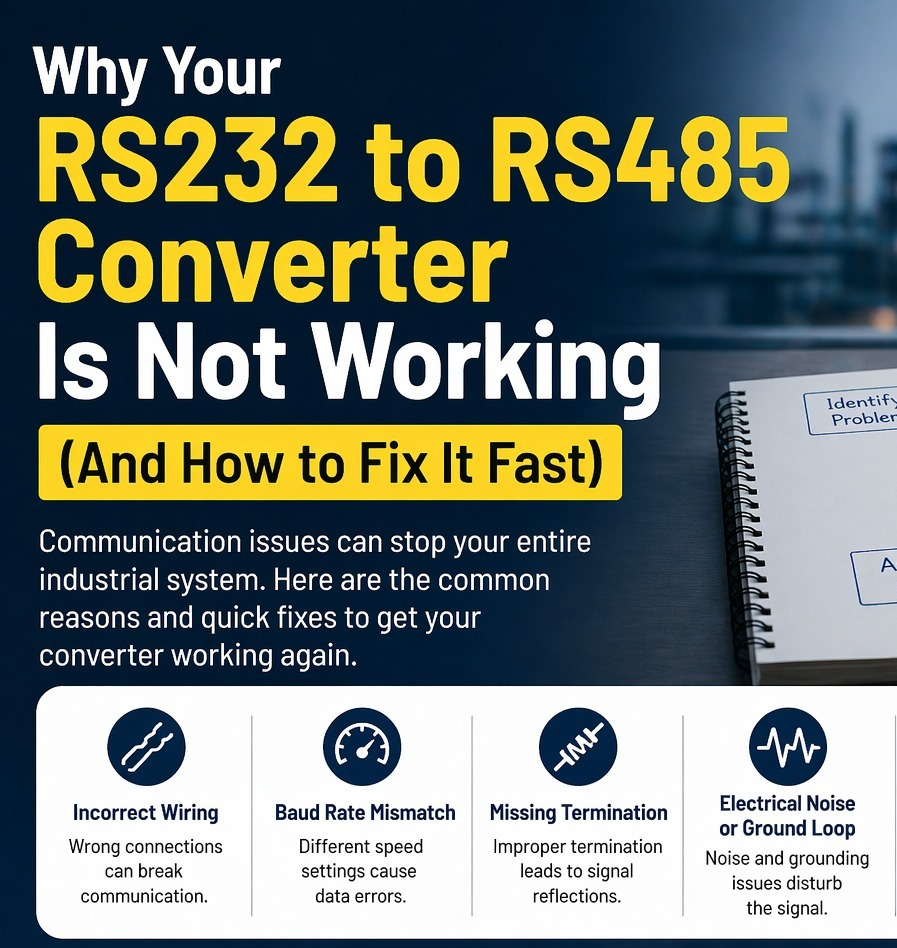
When your rs232 to rs485 converter stops working, it can bring your entire communication network to a halt. For industrial environments in India, especially across Pune and Maharashtra this often means disrupted data flow between PLCs, SCADA systems, and field devices.
A faulty converter doesn’t just affect connectivity; it leads to downtime, production loss, and delayed decision-making.
The good news? Most issues with an RS232 to RS485 converter are common, diagnosable, and fixable within minutes; if you know where to look.
This guide breaks down the most frequent problems and gives you practical, fast solutions.
What Does an RS232 to RS485 Converter Do?
An RS232 to RS485 converter enables communication between devices using different serial protocols.
In industrial systems, it is used for:
- Connecting legacy RS232 devices to modern RS485 networks
- Enabling long-distance communication (up to 1200 meters)
- Integrating PLCs, HMIs, SCADA systems, and sensors
Without a reliable converter, your automation system cannot function seamlessly.
Top Reasons Why Your RS232 to RS485 Converter Is Not Working
1. Incorrect Wiring (Most Common Issue)
Problem: Wrong wiring between RS232 and RS485 terminals.
Symptoms:
- No communication
- Data not transmitted
- Devices not detected
Fix:
- Check TX, RX, and GND connections
- Ensure A(+) and B(-) lines are correctly connected
- Verify pin configuration
Pro Tip: Always follow the wiring diagram provided with your converter.
2. Baud Rate Mismatch
Problem: Devices are configured with different communication speeds.
Symptoms:
- Garbled data
- Partial communication
- Communication errors
Fix:
- Set same baud rate on both devices
- Match parity, data bits, and stop bits
Example: If one device is set at 9600 baud and the other at 19200, communication will fail.
3. No Proper Termination in RS485 Network
Problem: Missing or incorrect termination resistors.
Symptoms:
- Signal reflection
- Unstable communication
- Intermittent data loss
Fix:
- Add 120-ohm termination resistors at both ends
- Avoid multiple terminations
4. Ground Loop or Electrical Noise
Problem: Industrial environments introduce noise and voltage differences.
Symptoms:
- Random disconnections
- Data corruption
- Unstable communication
Fix:
- Use isolated converters
- Ensure proper grounding
- Avoid running cables near high-power lines
5. Faulty or Low-Quality Converter
Problem: Using non-industrial-grade converters.
Symptoms:
- Frequent failure
- Inconsistent performance
- Short lifespan
Fix:
- Upgrade to industrial-grade solutions like Avyanna Tech’s RAKSHA Series
- Ensure surge protection and isolation
6. Power Supply Issues
Problem: Insufficient or unstable power supply.
Symptoms:
- Converter not turning ON
- Random shutdowns
Fix:
- Check voltage levels
- Use regulated power supply
- Avoid voltage fluctuations
7. Cable Length or Quality Issues
Problem: Exceeding RS485 distance limits or using poor cables.
Symptoms:
- Weak signals
- Communication drop over distance
Fix:
- Use shielded twisted pair cables
- Keep within recommended distance
- Use repeaters if needed
Quick Troubleshooting Checklist (Save Time)
Before replacing your converter, check:
- Wiring connections correct
- Baud rate matched
- Termination resistors installed
- Power supply stable
- Cable quality good
- Noise and grounding handled
This simple checklist solves most issues instantly.
Real Industrial Example
A manufacturing plant in Maharashtra faced communication failure between SCADA and field devices.
Issue: RS232 to RS485 converter not working due to:
- Wrong wiring
- No termination
Solution:
- Corrected wiring
- Added termination resistors
Result:
- Communication restored within 30 minutes
- Zero downtime loss
Why Industrial-Grade Converters Matter
Not all converters are built for industrial use.
Avyanna Tech’s RAKSHA Series converters are designed for:
- Harsh environments
- Electrical noise protection
- Stable long-distance communication
- Seamless integration with PLC & SCADA
Key Features to Look for in a Converter
When selecting an rs232 to rs485 converter, ensure it offers:
- Signal isolation
- Surge protection
- Wide operating temperature range
- Reliable data transmission
- Compact industrial design
FAQs
1. Why is my RS232 to RS485 converter not working?
Common reasons include wiring issues, baud rate mismatch, lack of termination, and power supply problems.
2. How do I test an RS232 to RS485 converter?
Check wiring, verify settings, and test with known working devices or loopback testing.
3. What is the maximum distance for RS485 communication?
Up to 1200 meters under ideal conditions.
4. Do I need termination resistors?
Yes, for stable communication, especially in long-distance networks.
5. Which converter is best for industrial use?
Industrial-grade converters with isolation and surge protection, such as Avyanna Tech’s RAKSHA Series.
Conclusion: Fix Faster, Operate Smarter
A malfunctioning rs232 to rs485 converter doesn’t always mean replacement. Most issues are simple and fixable with the right approach.
By understanding common problems and applying quick fixes, you can:
- Reduce downtime
- Improve system reliability
- Save maintenance costs
Looking for reliable industrial converters? Explore Avyanna Tech’s RAKSHA Series.
Ensure stable communication across your automation systems with trusted, Made-in-India solutions built for industrial performance.
[email protected]