
How to Choose an RS485 Isolator Repeater for Noisy Industrial Networks
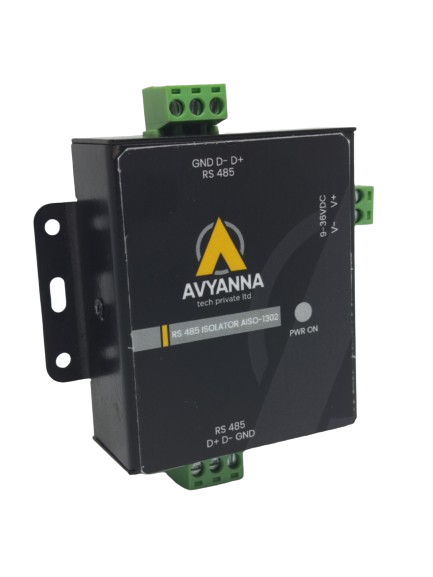
RS485 Isolator Repeater: How to Choose the Right One
An RS485 isolator repeater solves two problems at once: electrical isolation to protect against ground loops and noise, and signal regeneration to extend an RS485 network beyond its standard distance and device limits. In electrically noisy industrial environments – facilities with motors, variable frequency drives (VFDs), welding equipment, or long cable runs spanning multiple buildings – a standard isolator alone often isn’t enough, and a plain repeater without isolation leaves the network vulnerable to the exact noise problems that cause data errors in the first place.
Choosing the right isolator RS485 repeater for a genuinely noisy network means comparing a specific set of technical specifications: isolation voltage, distance extension capability, device count support, and data rate handling. Get these wrong, and the unit either fails to solve the underlying noise problem or becomes an unnecessary bottleneck on network performance.
This guide walks through exactly what to compare when selecting an RS485 isolator repeater for a demanding, electrically noisy industrial network.
What Makes a Network “Noisy” Enough to Need an Isolator Repeater?
Before comparing specific products, it’s worth confirming that a facility’s RS485 network actually qualifies as electrically noisy – not every installation needs this level of protection. Common indicators include:
- Proximity to motors, VFDs, or large switching loads that generate electromagnetic interference (EMI)
- Multiple power sources feeding devices on the same RS485 bus, creating potential ground potential differences
- Cable runs crossing between buildings or separately grounded electrical zones
- A documented history of intermittent, hard-to-diagnose communication errors not explained by cabling or termination issues
- Outdoor or exposed cable runs with lightning or surge exposure risk
If several of these apply, an RS485 isolator repeater – rather than a standard repeater or basic isolator alone – is typically the right category of device to evaluate.
Key Specifications to Compare in an RS485 Isolator Repeater
1. Isolation Voltage Rating
Compare the isolation voltage rating across candidate units – commonly ranging from 1,500V to 3,000V or higher. In genuinely noisy environments with significant ground potential differences or surge exposure risk, prioritizing units at the higher end of this range provides a larger protective margin.
2. Maximum Extended Distance
Standard RS485 supports cable runs up to roughly 1,200 meters (4,000 feet) before signal degradation becomes a concern. Compare how much additional distance each isolator repeater adds when placed at points along the network – this varies by manufacturer and should be confirmed against your facility’s actual layout and cable run distances.
3. Device Count Support
Standard RS485 networks support up to 32 devices without additional hardware. Compare how many additional devices each isolator repeater allows the network to support, since this varies between models and directly affects whether a single unit meets your facility’s device count needs or whether multiple repeaters are required.
4. Data Rate and Latency
Compare the maximum supported baud rate and confirm the isolator repeater doesn’t introduce meaningful latency at your network’s operating speed. Some lower-cost units handle isolation and repeating adequately at lower baud rates but introduce noticeable delay or error rates at higher speeds – verify this specifically against your network’s actual data rate requirements.
5. Automatic vs. Manual Direction Sensing
For RS485 networks using half-duplex communication, compare whether the isolator repeater includes automatic direction sensing (detecting transmit vs. receive state automatically) versus requiring manual configuration. Automatic sensing simplifies installation and reduces the risk of configuration errors, particularly valuable when deploying multiple units across a facility.
6. Built-In Termination and Bias Networks
Compare whether the unit includes built-in termination resistors and bias networks, which help maintain signal integrity at each repeater point along an extended network. Without these, additional external components may be needed at each isolator repeater location, adding installation complexity.
7. Environmental and Mounting Specifications
Since these units are typically installed in control cabinets or distributed across a facility, compare DIN-rail mounting compatibility, operating temperature range, and enclosure rating – particularly important if any repeater points will be installed outside a climate-controlled cabinet.
8. Power Requirements at Each Repeater Point
Since an isolator repeater is often installed mid-network rather than only at the endpoints, compare power input requirements and confirm power is available (or can be reasonably run) at each planned repeater location before finalizing placement.
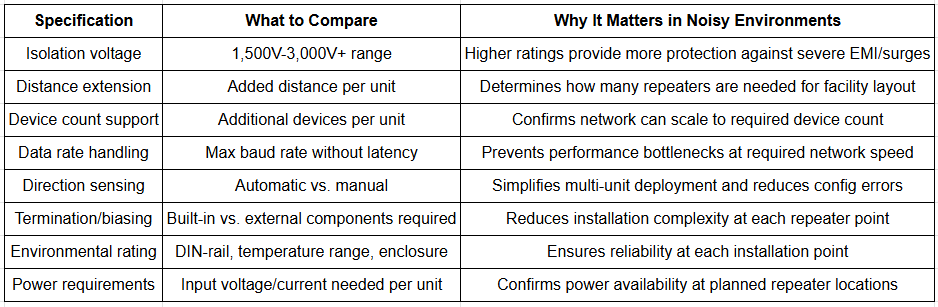
RS485 Isolator Repeater Comparison Checklist
Where to Place RS485 Isolator Repeaters on a Noisy Network
Placement matters as much as the unit’s specifications. Consider positioning isolator repeaters:
- At building or electrical zone boundaries, where ground potential differences are most likely to occur
- Near known sources of EMI, such as motor rooms or areas with VFD-controlled equipment, to isolate that segment from the rest of the network
- At maximum standard RS485 distance points (approximately every 1,200 meters), to maintain signal integrity before it degrades
- Before reaching the 32-device limit on a segment, to allow additional devices to be added on a fresh segment
RS485 Isolator Repeater vs. Standard RS485 Isolator: When You Need the Repeater Function
If your network’s only problem is electrical noise from ground loops or EMI – without any distance or device count limitations – a standard RS485 isolator may be sufficient on its own. An RS485 isolator repeater becomes necessary specifically when noise protection needs to be combined with extending the network beyond standard RS485 distance (1,200 meters) or device count (32 devices) limits. Facilities with long cable runs spanning multiple noisy zones, or networks needing both extended reach and noise immunity, are the clearest use case for the combined isolator repeater function.
Frequently Asked Questions
What is an RS485 isolator repeater used for?
An RS485 isolator repeater combines electrical isolation, which protects against ground loops and noise, with signal regeneration, which extends an RS485 network beyond its standard distance and device count limits – making it well-suited for long, electrically noisy industrial networks.
How do I know if I need an RS485 isolator repeater instead of a standard isolator?
You likely need the repeater function specifically if your network requires extending beyond RS485’s standard 1,200-meter distance limit or 32-device count, in addition to needing noise protection. If distance and device count aren’t concerns, a standard isolator without repeating may be sufficient.
How far can an RS485 isolator repeater extend a network?
This varies by manufacturer and model, but isolator repeaters are generally designed to add significant additional distance beyond RS485’s standard 1,200-meter limit when placed at appropriate intervals along the network – confirm the specific distance rating for each candidate unit.
Where should RS485 isolator repeaters be placed on a network?
Isolator repeaters are typically placed at building or electrical zone boundaries, near known sources of electromagnetic interference, at maximum standard RS485 distance points, and before reaching the standard 32-device limit on a network segment.
Do RS485 isolator repeaters slow down data communication?
Quality isolator repeaters are designed to support standard RS485 baud rates without significant latency, though it’s worth confirming the specific unit’s data rate handling against your network’s operating speed, since lower-cost units can introduce noticeable delay at higher baud rates.
Choose Based on Your Network’s Actual Noise and Distance Profile
Selecting the right RS485 isolator repeater for a noisy industrial network comes down to matching isolation voltage, distance extension, and device count capability to your facility’s actual conditions – not simply choosing the highest-rated unit available. Confirming these specifications against your network’s real noise sources, cable distances, and device count needs ensures the repeater solves the problem it’s meant to solve, without becoming an unnecessary cost or bottleneck.
At Avyanna Tech, we help engineers and system integrators select the right RS485 isolator repeater or standard isolator RS485 device for their specific network conditions. Contact us to explore our full range of isolation solutions and keep your noisy RS485 network running reliably at the distance and scale your facility needs.

[email protected]