Remote Terminal Unit vs PLC: Which Is Better for Distributed Industrial Monitoring?
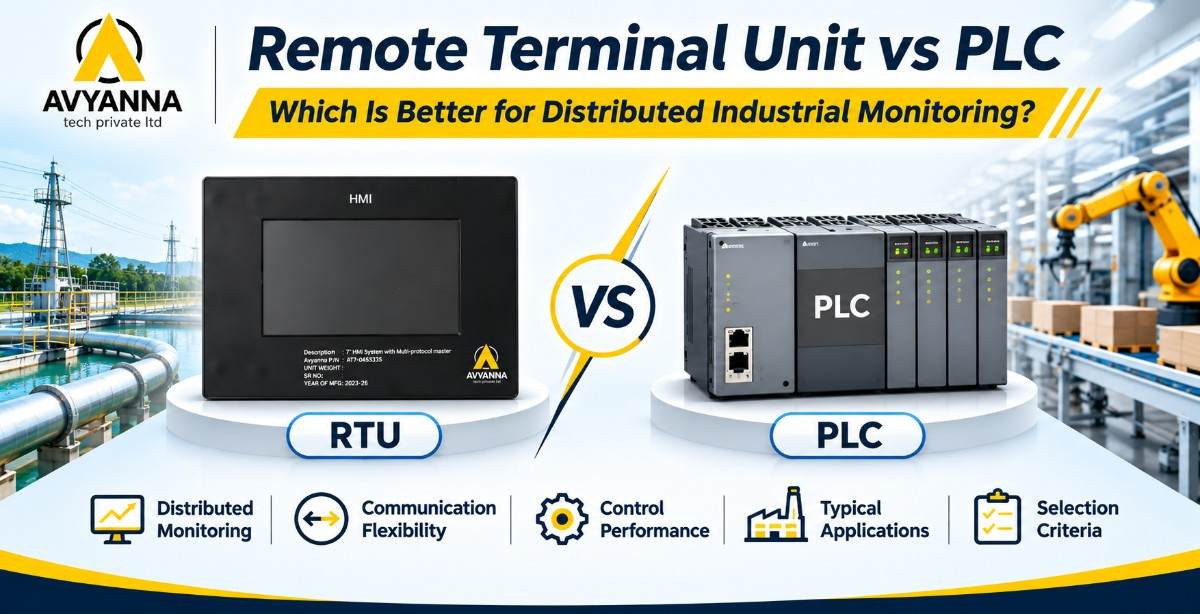
The choice between an Remote Terminal Unit (RTU) and a Programmable Logic Controller (PLC) comes down to how the system takes data, how it communicates with the equipment and how it reacts to changing conditions. Both are very much in use in the industrial automation world, just designed around different sets of requirements. The RTU is the device of choice when you’re looking at remote data acquisition and remote monitoring across a number of sites. The PLC is the device of choice when you’re looking at fast, deterministic machines and process control.
For an industrial site that has remote pumps, a water treatment plant, power distribution assets, pipelines or some manufacturing equipment, the right controller can have a huge bearing on the reliability of the communication, the response time, the level of maintenance required and the total cost of the system. Knowing the difference between an RTU and a PLC is essential to the engineer in order to select the right solution for the application rather than just go on the label.
What Is the Difference Between an RTU and a PLC?
A Remote Terminal Unit (RTU) is generally designed to collect field data, communicate with supervisory systems and monitor equipment at remote locations. A Programmable Logic Controller (PLC) is primarily designed to execute control logic and automate machines or industrial processes. Both can perform monitoring and control, so the better choice depends on communication requirements, response time and operating conditions.
An RTU typically gathers information from sensors, meters, switches and other field devices before transmitting it to a supervisory control and data acquisition (SCADA) system. Depending on the model, it may support remote communications, event reporting, local control logic and operation during intermittent connectivity.
A PLC receives inputs, executes a programmed sequence or control algorithm and updates outputs to operate machinery or processes. It is commonly used for conveyor systems, packaging machines, production lines, pump control and other applications where predictable control-cycle performance is important.
The distinction is not absolute. Modern RTUs can execute local control logic, while many PLCs support Ethernet, remote communications and SCADA integration. Compare the actual capabilities of the devices rather than assuming every RTU or PLC has the same features.
RTU vs PLC: Key Differences at a Glance
The fundamental difference between an RTU and a PLC is really down to what they’re designed to do. RTUs are typically designed for remote monitoring, telemetry, a wide range of communications and operation at a distributed site. PLCs are generally designed for local automation, fast control and integration with the machine. Of course the modern day devices are very much in overlap so you do need to check I/O, the communications, the environmental ratings and the actual control performance.
| Comparison factor | Remote Terminal Unit (RTU) | Programmable Logic Controller (PLC) |
| Primary purpose | Remote monitoring, telemetry and field data collection | Machine and process automation |
| Typical location | Geographically dispersed or unattended sites | Machines, production lines and plant control panels |
| Communication | May support serial, Ethernet, cellular, radio or other telemetry interfaces | Often supports industrial Ethernet, serial networks and fieldbus interfaces |
| Control capability | Monitoring and local control, depending on the model | Programmable logic and real-time control |
| Response requirements | Depends on the application and RTU design | Often selected for predictable, fast control cycles |
| Power requirements | Some models support low-power or backup-powered deployments | Depends on the PLC, I/O modules and installation |
| Environmental suitability | Models may be designed for remote or harsh environments | Industrial models are available for a wide range of environments |
| Common applications | Remote pumping stations, utilities, pipelines and distributed assets | Packaging, conveyors, machine control and manufacturing |
| SCADA integration | Commonly used for telemetry and supervisory monitoring | Also widely integrated with SCADA systems |
| Best selection criterion | Remote access, communications and autonomous site operation | Control performance, logic complexity and machine integration |
These are general tendencies, not universal rules. Always consult the technical documentation for the specific RTU or PLC being considered.
When Should You Choose an RTU for Distributed Industrial Monitoring?
Choose an RTU if your application is one of collecting data from remote or widely dispersed equipment and sending it to a central monitoring system. They’re ideal for unattended sites, for situations where communications are intermittent, for telemetry and for distributed infrastructure. Make sure the model you select supports the required communication interfaces, local control functions, power options and environmental specs.
RTUs are often used where the industrial assets are spread out over a large area and you can’t have a continuously staffed control room at every site. Typical examples would be water distribution networks, remote pumping stations, pipelines, substations and environmental monitoring sites.
An RTU based system can take measurements such as pressure, flow, temperature, tank level, voltage, equipment status etc. It can then pass that data on to a SCADA system or some other compatible supervisory system depending on its communications capability.
Consider an RTU when your application requires:
- Monitoring equipment across multiple remote locations.
- Collecting data from sensors and field instruments.
- Sending telemetry to a central SCADA system.
- Operating with radio, cellular or other remote communication links.
- Recording or reporting events when supported by the device.
- Maintaining specified local functions during communication interruptions.
- Supporting remote diagnostics and maintenance.
An RTU does not automatically guarantee continuous connectivity or uninterrupted operation. Those outcomes depend on power backup, communication coverage, configuration, storage capacity and the overall system design.
When Is a PLC the Better Choice?
A PLC is generally the better choice when you’re looking at controlling a machine or an industrial process via programmed logic. It’s the ideal solution for sequencing, interlocks, sensor feedback, motor control and the co-ordination of various pieces of equipment. A PLC is selected on the basis of control cycle, I/O, programming capabilities, safety and compatibility with the other equipment.
PLCs are extremely widely used in manufacture as they can read inputs repeatedly, execute the control logic and update the outputs in a very predictable sequence. Whether or not they are the right choice will depend on the required response time, the nature of the control required and the specifications of the PLC you’ve selected.
For example a packaging machine may have to co-ordinate sensors, actuators, conveyor motors and product positioning. The PLC can then run the programmed sequence and react to changing input conditions in accordance with the timing requirements of the application.
A PLC is often a good fit when you need:
- Fast, repeatable machine-control logic.
- Sequencing and interlocking between equipment.
- Coordinated control of motors, valves and actuators.
- Integration with industrial sensors and I/O modules.
- Local process automation with defined response requirements.
- Communication with an HMI or SCADA system.
- Expansion through compatible I/O or communication modules.
Not every PLC is designed for every control task. Applications involving motion control, high-speed processing or functional safety may require specialised hardware and appropriate certification.
RTU vs PLC for SCADA Systems
Both RTUs and PLCs can connect to SCADA systems. An RTU is often selected for gathering telemetry from remote assets, while a PLC commonly provides the local control logic for machinery or processes. The right choice depends on whether the site prioritises remote data collection, local control performance or a combination of both.
SCADA systems allow operators to supervise industrial processes, view measurements, monitor alarms and issue authorised commands. Field controllers provide the data and control functions needed to support that supervisory layer.
An RTU may communicate with a central SCADA system over a suitable serial, Ethernet, cellular or radio connection. A PLC may communicate with SCADA over industrial Ethernet, serial communications or a supported protocol. The available options vary by model and configuration.
Connecting serial-based controllers and instruments to Ethernet requires suitable interface and communication compatibility. Read our guide on serial-to-Ethernet converter compatibility for PLC and SCADA.
When assessing an RTU or PLC for SCADA integration, verify:
- Protocol compatibility between the field device and SCADA platform.
- Required data points, tags, registers and update intervals.
- Alarm and event handling requirements.
- Communication-loss behaviour and recovery procedures.
- Remote access controls and cybersecurity requirements.
- Time synchronisation and event timestamping, where required.
- Support for the necessary data acquisition and control functions.
A compatible communication interface alone does not guarantee successful integration. Device addressing, register mapping, data types, polling settings and the SCADA configuration must also be correct.
Can an RTU and PLC Work Together?
Yes. An RTU and a PLC can work together when an application requires both local automation and remote monitoring. The PLC can manage time-critical machine operations, while the RTU collects site data and communicates with a supervisory system. The design must define control ownership, data exchange, failure behaviour and communication interfaces to avoid conflicting commands.
Consider a remote water pumping installation. A PLC could control pump sequencing, motor interlocks and local operating conditions. An RTU could collect tank levels, flow measurements, pump status and alarm information before transmitting it to the central SCADA system.
This arrangement can be useful when a site has demanding local control requirements alongside geographically distributed monitoring needs. However, a separate RTU and PLC are not always necessary. Some modern controllers combine relevant functions, which may simplify installation and maintenance.
RTUs and PLCs can work together in distributed automation systems, particularly when field devices and controllers need to exchange information across different networks. An industrial gateway server can help connect legacy equipment with modern Ethernet-based infrastructure by providing the required communication interface. To understand how these connections work, read our guide on how an industrial gateway server helps connect legacy equipment to modern networks.
Before deploying both devices, decide:
- Which controller owns each control function.
- Which measurements and statuses must be exchanged.
- How the devices communicate with one another.
- What happens if the network or supervisory system becomes unavailable.
- Which commands are permitted from remote operators.
- How alarms, timestamps and equipment states are synchronised.
- How the system will be tested after communication failures.
The architecture should ensure that essential local control does not depend unnecessarily on a remote network connection. Remote commands should also be subject to suitable interlocks, access controls and operating procedures.
RTU vs PLC: Which Is More Cost-Effective?
Neither RTUs nor PLCs are universally cheaper. The overall cost depends on hardware, I/O modules, communication equipment, installation, software, power requirements, commissioning and long-term maintenance. An RTU may suit a remote telemetry application with specialised communication needs, while a PLC may be more economical for a machine requiring extensive local control.
The purchase price is only one part of the cost. A low-cost controller may require additional communication modules, external modems, power equipment or engineering work to meet the application’s requirements.
Compare the total installed cost across the expected operating life, including:
- Controller and I/O hardware.
- Sensors, actuators and field wiring.
- Network infrastructure and communication subscriptions.
- Enclosures, power supplies and backup power.
- Programming, integration and commissioning.
- Spare parts, diagnostics and maintenance.
- Training, cybersecurity and future expansion.
For a small machine, a PLC may be the simplest option. For numerous remote monitoring points, an RTU with suitable telemetry features may reduce integration complexity. A combined architecture can also be appropriate where the application justifies it.
Request a quotation based on the required functions and site conditions rather than comparing controller prices in isolation.
How to Choose Between an RTU and a PLC
Start by defining whether the main requirement is remote monitoring, local control or both. Then document the number and type of I/O points, communication protocols, response times, power availability, environmental conditions and SCADA requirements. Compare specific devices against these requirements and select the architecture that meets operational needs without unnecessary complexity.
Use the following decision guide as an initial screening tool:
| Your requirement | Option to evaluate first |
| Monitoring assets across distant sites | RTU |
| Collecting telemetry from remote instruments | RTU |
| Controlling a packaging or conveyor machine | PLC |
| Executing repetitive, time-sensitive control logic | PLC |
| Integrating remote monitoring with local automation | RTU and PLC, or a suitable combined controller |
| Connecting field devices to SCADA | RTU or PLC, depending on the application |
| Operating with limited power at remote sites | A suitable low-power RTU or controller |
| Performing specialised motion or safety control | A controller specifically rated for that function |
Before finalising the choice, review the following technical requirements.
1. I/O capacity: Identify the required digital inputs, digital outputs, analog inputs and analog outputs. Include future expansion where appropriate.
2. Communication: Check the required serial and Ethernet interfaces, network protocols, remote connectivity and integration with existing equipment.
3. Control performance: Determine the required response times, scan cycle, control algorithms and behaviour during faults.
4. Operating conditions: Confirm temperature, humidity, vibration, electrical noise and enclosure requirements.
5. Reliability and maintenance: Review diagnostics, backup power, replacement availability, engineering tools and support arrangements.
6. Security: Evaluate authentication, network segmentation, remote-access controls, firmware maintenance and the cybersecurity requirements applicable to the installation.
The best solution is the one that meets the application’s functional and operational requirements—not simply the one labelled RTU or PLC.
How Avyanna Tech Supports Industrial Connectivity
Avyanna Tech provides industrial connectivity and automation products, including Remote Terminal Units, Remote I/O modules, Modbus gateways and serial device servers. These product categories address different parts of an industrial communication architecture, so selection should begin with the required monitoring, control and connectivity functions.
For distributed monitoring projects, assess the required field interfaces, communication protocols, I/O configuration and connection to the supervisory system. For machine-level automation, evaluate the control requirements and compatibility of the controller with the existing equipment.
Avyanna Tech’s industrial product range can be reviewed to identify suitable connectivity components for an application. Confirm the specifications of the individual model before making a purchase, especially when the project has specific requirements for environmental protection, communications or local control.
Common Myths About RTUs and PLCs
RTUs are not limited to monitoring, and PLCs are not limited to factory automation. Both can support monitoring, control and SCADA integration, depending on their capabilities. The correct choice depends on response-time requirements, communication options, operating conditions and application needs, not simply whether a device is labelled an RTU or PLC.
Several outdated assumptions can lead to poor controller selection. Modern industrial devices have overlapping capabilities, so engineers should evaluate the actual specifications rather than rely on traditional definitions alone.
Myth 1: An RTU can only collect data.
Many RTUs can execute local logic, operate outputs and perform predefined actions without continuously relying on a central SCADA system. However, the complexity and speed of local control vary by model. Always verify whether the selected RTU supports the required control functions.
Myth 2: A PLC cannot support remote monitoring.
Many PLCs offer Ethernet connectivity, serial communication, remote diagnostics and integration with supervisory systems. A PLC can be suitable for remote monitoring when the communication infrastructure and controller capabilities meet the application’s requirements.
Myth 3: RTUs are always better for remote locations.
An RTU may be well suited to a remote installation, but the decision also depends on power availability, communication coverage, environmental ratings, maintenance access and control requirements. A suitably specified PLC may be sufficient for some remote applications.
Myth 4: RTUs are always cheaper and consume less power.
Cost and power consumption depend on the hardware configuration, communication interfaces, I/O modules and operating conditions. Compare the complete system rather than assuming that one controller category is automatically more economical.
Myth 5: A gateway can replace every RTU or PLC.
An IoT gateway may collect and transmit data, but it does not necessarily provide the deterministic control, I/O handling or autonomous operation required by an industrial process. Confirm the functions supported by each device before deciding to replace a controller.
The practical lesson is simple: define the required functions first, then select the controller that meets them reliably.
RTU vs PLC vs PAC vs IoT Gateway: Understanding the Differences
An RTU is typically used for remote monitoring and telemetry, a PLC for machine and process control, a PAC for more complex or integrated automation, and an IoT gateway for data gathering and the communication of that data between the devices and the software platforms. There is of course some overlap between these categories so you need to look at control performance, I/O, protocols, computing and security before you make your selection.
Although they can communicate with the same type of equipment they are not in any application interchangeable.
| Device | Primary role | Common applications | What to verify |
| Remote Terminal Unit (RTU) | Remote data acquisition, telemetry and, where supported, local control | Remote pumping stations, utilities, pipelines and distributed assets | Telemetry interfaces, local logic, power and environmental specifications |
| Programmable Logic Controller (PLC) | Programmed machine and process control | Conveyors, packaging machines, production lines and pump control | Control-cycle performance, I/O capacity, programming and communications |
| Programmable Automation Controller (PAC) | Integrated automation involving more complex control, data handling or coordination | Process automation, multi-axis systems and larger integrated installations | Processing capabilities, supported programming models, networking and system architecture |
| Industrial IoT gateway | Data aggregation and communication between industrial equipment and higher-level platforms | Equipment monitoring, remote data access and industrial data integration | Protocol support, data handling, connectivity, cybersecurity and whether control is supported |
A PAC is frequently positioned somewhere between the traditional PLC and the more integrated automation system, the line being very much manufacturer dependent. Some PLCs have a very high level of processing and networking capability, others PACs are very much in the same programming and hardware environment as a PLC.
An industrial IoT gateway is generally going to be a device that’s going to be looking at connecting devices, pulling the data off them and then sending that on to the software. It’s not necessarily going to be a device that’s going to be replacing a controller that’s doing safety critical or time critical control.
How should you choose?
- Choose an RTU when distributed monitoring and remote telemetry are central requirements.
- Choose a PLC when the application needs dependable local machine or process control.
- Evaluate a PAC when the application requires more advanced or integrated automation capabilities.
- Consider an IoT gateway when the priority is data integration, remote visibility or connectivity between existing equipment and higher-level systems.
In some installations, the best architecture combines a controller with a gateway rather than expecting one device to perform every function.
Local Control vs Telemetry: What Must the Site Do on Its Own?
Any function which has to continue to operate safely and predictably in the event of a communication failure must be dealt with locally by some suitable controller or independent protection system. Telemetry will allow remote systems to monitor the situation and pass commands, but it should not be the only thing that the system is dependent upon. You need to define what functions are absolutely essential to operate independently before you go any further in the selection of an RTU, a PLC or a combination of the two.
A remote monitoring system generally has two separate jobs: to control the equipment at the site and to pass on the operational information to a central location.
Local control is responsible for things like maintaining operating limits, managing sequences, checking interlocks and responding to field inputs. Telemetry is the mechanism by which measurements, equipment status, alarms and the commands which are permitted to be issued are passed from the remote site to a supervisory system.
For instance a remote pumping station may be required to stop a pump in the event of a local protection condition occurring, even if the cellular link to the control room is down. The required action would be achieved via appropriate local control and protection.
Before deployment, classify functions into three groups:
- Essential local functions: Actions that must continue or occur safely without external communication.
- Supervisory functions: Monitoring, reporting, setpoint changes and authorised remote commands.
- Recovery functions: Reconnection, alarm reporting, data synchronisation and restoration of normal operation after a fault.
Also establish what happens when the comms fail. It will depend on the process in question whether the system simply carries on locally, enters a pre-defined fallback mode, stops some of the operations or requires an operator to take over.
The correct behaviour is dictated by the process hazard analysis and the engineering requirements. Neither an RTU nor a PLC in themselves will ensure safe operation just because they have local logic.
When looking at an RTU for distributed monitoring, check the local control functions it supports, its behaviour on communication loss and its recovery options. If you’re looking at it for a more complex or fast control application then you need to consider whether a PLC or a hybrid architecture is the better option.
Power Requirements and Low-Power Operation
Low power operation is important when you’re looking at industrial monitoring equipment to be deployed at remote sites where mains power is limited, or where you’re using battery or solar power. You need to look at the controller’s power consumption in its actual operating configuration (i.e. with all the I/O modules, comms gear and peripherals installed). You also need to look at battery autonomy, charging conditions, transmission frequency and power requirements during start up and during transmission.
Remote industrial installations may have a lot less in the way of power options than a staffed factory. A controller that would be perfectly happy in a powered up control room might well need a different set of options at a solar powered pumping station or a remote monitoring point.
Before you go and pick an RTU or PLC, work out your expected system power budget. Don’t just compare the controllers on the basis of their headline power consumption if one of the configurations is going to require additional comms gear or external modules.
Consider the following:
- Controller consumption: Review typical and maximum power requirements from the manufacturer’s documentation.
- Communication load: Cellular modems, radio equipment and Ethernet devices may add significant power demand.
- I/O configuration: The number and type of connected modules can affect total consumption.
- Battery autonomy: Calculate how long the system must operate without recharging or mains power.
- Solar conditions: Account for seasonal sunlight, charging losses and local installation constraints.
- Reporting frequency: More frequent data transmission can increase energy consumption.
- Startup and recovery: Check power requirements when communication equipment reconnects or peripherals start.
Power-saving modes can reduce consumption, but they must be compatible with the monitoring requirements. For example, sleeping or switching off a communication interface may delay alarms or data reporting.
For a remote site, the correct solution balances power consumption with the required reporting interval, availability and response time. Validate the complete system design rather than choosing a controller based on a low-power claim alone.
Environment, Ruggedness and Certifications
Pick an RTU or PLC with documented environmental and electrical specs appropriate for the site it’s going to be installed at. You’ll need to check the operating temperature, humidity, vibration, shock, EMC, enclosure rating and any relevant certifications. If it’s a remote or outdoor unit you’ll likely be looking at additional protection against moisture, dust, temperature variations and electrical transients depending on the actual site conditions.
Industrial equipment can be used in control rooms, outdoor cabinets, pumping stations, utility installations and in any environment where there’s likely to be vibration and/or electrical noise. The controller has to be appropriate for the environment in which it’s going to be operating.
When reviewing specifications, consider:
- Operating temperature: Confirm the permitted temperature range for the complete installed configuration.
- Humidity and condensation: Check environmental limits and enclosure requirements.
- Ingress protection: Select suitable protection against dust and water based on the installation.
- Vibration and shock: Verify ratings where equipment may be exposed to mechanical movement.
- Electromagnetic compatibility: Review immunity and emissions documentation for the intended environment.
- Electrical protection: Evaluate isolation and surge protection where required.
- Certifications: Confirm the exact standards, approvals and regional requirements applicable to the application.
A product described as industrial grade does not necessarily meet every environmental requirement. Likewise, an enclosure rating does not automatically apply to the entire installation if cable entries, connectors or mounting arrangements compromise protection.
Certifications should be checked against the intended use, location and applicable regulations. Do not assume that every RTU or PLC carries the same approvals or is suitable for hazardous areas.
For outdoor or unattended sites, consider the enclosure, power supply, communications hardware and controller as one integrated installation. Correct cabinet design, grounding, ventilation and maintenance access are essential to long-term reliability.
Cybersecurity for Remote Industrial Sites
Secure remote industrial controllers by restricting network access, using strong authentication, segmenting operational technology networks and maintaining supported firmware. Disable unnecessary services, protect remote connections and monitor access where feasible. Security controls must be compatible with the process and validated before deployment so that protective changes do not interrupt essential industrial operations.
RTUs and PLCs increasingly communicate with SCADA systems, remote engineering tools and enterprise networks. This connectivity improves visibility and maintenance, but it also creates pathways that must be protected against unauthorised access and operational disruption.
A practical security review should cover the controller, communication links, remote-access equipment and supervisory software.
Key cybersecurity measures include:
- Network segmentation: Separate operational technology systems from general office networks and restrict traffic between them.
- Access control: Give users only the permissions required for their responsibilities.
- Strong authentication: Use appropriate authentication controls for engineering tools and remote access.
- Secure remote connections: Use approved, encrypted access methods where supported and required.
- Firmware maintenance: Track security advisories and apply supported updates through a controlled process.
- Service reduction: Disable unused interfaces and services when safe and supported.
- Monitoring and logging: Record access and configuration changes where the equipment and system support them.
- Recovery planning: Maintain configuration backups and test recovery procedures.
Remote access should not be exposed directly to the public internet without a carefully designed security architecture. A VPN alone is not a complete security strategy; access permissions, endpoint security, network restrictions and monitoring also matter.
For industrial systems, security changes should follow a documented change-management process. Test updates and configuration changes before deployment, especially when a controller operates a critical process.
When selecting an RTU, PLC or IoT gateway, ask the supplier about supported authentication methods, firmware support, secure communication options and the process for receiving security updates. The suitability of a device depends on its documented capabilities and the controls implemented around it.
RTU and PLC Use Cases by Industry
RTUs are commonly suited to monitoring geographically dispersed assets, while PLCs are widely used for local machine and process control. Utilities, water networks, energy infrastructure and pipelines often need telemetry across remote locations. Manufacturing and packaging facilities often need programmed machine control. Some industries require both functions, making an integrated RTU–PLC–SCADA architecture appropriate.
The best controller depends on the site’s physical layout, control requirements and communication infrastructure. The following examples illustrate common selection patterns rather than fixed rules.
| Industry or application | Typical requirement | Architecture to evaluate |
| Water distribution | Monitoring reservoir levels, flow and remote pumping stations | RTUs for remote telemetry; PLCs for local pump control where required |
| Energy and utilities | Supervisory monitoring of distributed infrastructure | RTUs or specialised controllers with suitable communications and approvals |
| Oil and gas | Monitoring remote assets and process conditions | RTUs, PLCs or specialised control systems based on the hazard and process requirements |
| Manufacturing | Coordinating machines, sensors, actuators and production sequences | PLCs or PACs for local automation |
| Packaging and material handling | Repeatable sequencing and equipment coordination | PLCs, with suitable motion or safety systems where required |
| Building and facility management | Monitoring distributed equipment and environmental conditions | Controllers and gateways chosen according to the protocols and control requirements |
| Environmental monitoring | Collecting measurements at remote stations | RTUs or data acquisition systems with suitable power and telemetry |
| Remote industrial pumping | Local pump protection plus central status monitoring | PLC, RTU or combined architecture based on the control and telemetry requirements |
Upgrading Existing PLC Sites for Remote Monitoring
Existing PLC installations can often be upgraded for remote monitoring without replacing the controller. First verify the PLC’s communication interfaces, supported protocols, data points and available network capacity. A suitable RTU, serial device server, industrial gateway or direct SCADA connection may provide the required connectivity, depending on whether the project needs telemetry, serial networking or protocol conversion.
Many industrial facilities have legacy PLCs that continue to control equipment reliably but provide limited remote visibility. Replacing these controllers may be unnecessary if the immediate goal is to collect operating data or connect the installation to a supervisory platform.
A staged upgrade begins with a technical assessment.
Step 1: Document the existing installation.
Identify the PLC model, firmware, available communication ports, supported protocols, I/O configuration and existing network architecture.
Step 2: Define the monitoring requirements.
Decide which values, equipment states, alarms and events need to be collected. Establish update intervals, retention requirements and the expected behaviour during communication failures.
Step 3: Choose the connection method.
Depending on the existing equipment, options may include:
- Direct connection to SCADA through a supported protocol.
- A serial device server to provide network access to compatible serial equipment.
- A Modbus gateway when the required protocol conversion is supported.
- An RTU for additional remote data acquisition or telemetry functions.
- An industrial IoT gateway for suitable data integration applications.
Step 4: Test before deployment.
Validate data mapping, polling intervals, communication reliability, access controls and recovery behaviour in a test environment or controlled commissioning window.
Step 5: Document and maintain the new architecture.
Update wiring diagrams, network diagrams, controller backups, configuration records and maintenance procedures.
A gateway or RTU should not be selected solely because it has a convenient connector. Confirm protocol compatibility, data types, addressing and the intended communication path.
For systems that control critical equipment, remote monitoring should be added without undermining existing interlocks or creating unsafe dependencies on external connectivity.
Maintainability and Lifecycle Planning
Maintainability depends on diagnostics, documentation, spare-part availability, configuration backups, firmware support and the skills needed to service the equipment. When comparing RTUs and PLCs, evaluate the expected life cycle cost rather than only the purchase price. A controller that is easy to diagnose, replace and recommission can reduce downtime and simplify long-term operation.
Industrial controllers often remain in service for years, so life cycle planning should begin before purchasing. A device that meets today’s requirements may become difficult to support if software tools, firmware or replacement hardware are no longer available.
Evaluate the following factors:
- Diagnostics: Check the availability of status indicators, fault logs and communication diagnostics.
- Documentation: Confirm that wiring diagrams, configuration instructions and technical manuals are accessible.
- Configuration backups: Establish a process for saving and restoring the device configuration.
- Spare parts: Review availability, lead times and replacement options.
- Firmware life cycle: Understand how updates and security advisories are communicated.
- Engineering skills: Consider whether the maintenance team can configure and troubleshoot the selected platform.
- Expansion: Check whether future I/O, communications or monitoring needs can be supported.
- Replacement planning: Document how the device will be tested and recommissioned after replacement.
For remote sites, maintenance access may be costly or difficult. Remote diagnostics can help identify communication faults and equipment status, but only when the necessary interfaces, connectivity and access controls are available.
A useful life cycle plan should include routine inspections, backup verification, access reviews, firmware management, spare-parts planning and periodic testing of recovery procedures.
The right controller is not just the one that works at commissioning. It should remain supportable throughout the expected service life of the industrial system.
Frequently Asked Questions
1. What is the main difference between an RTU and a PLC?
An RTU is commonly used for remote data acquisition, telemetry and supervisory monitoring across distributed locations. A PLC is commonly used to automate machines and industrial processes through programmed logic. Both can perform monitoring and control, so the appropriate choice depends on the application and the capabilities of the specific device.
2. Is an RTU better than a PLC for remote monitoring?
An RTU is often a suitable choice for remote monitoring because many models are designed for telemetry, distributed installations and remote communication. However, some PLCs also support remote monitoring effectively. Compare the required communication interfaces, power arrangements, I/O capacity and SCADA integration before deciding.
3. Can a PLC communicate with a SCADA system?
Yes. A PLC can communicate with a SCADA system through supported protocols and communication interfaces, including industrial Ethernet or serial connections. Successful integration depends on compatible protocols, correct device configuration, appropriate data mapping and the SCADA platform’s ability to interpret the information provided by the PLC.
4. Can an RTU perform control functions?
Yes. Many RTUs can execute local logic, process field inputs and control outputs, although the available functions vary by model. They can support certain autonomous operations when remote communication is unavailable, provided the device and application are designed for that behaviour.
5. Can RTUs and PLCs be used in the same system?
Yes. A PLC can manage local machine control while an RTU handles remote data acquisition and telemetry. This architecture is useful when both functions are required, but it needs clearly defined control ownership, compatible communication interfaces, suitable failure handling and secure remote access.
6. Which is more suitable for a water treatment plant: an RTU or a PLC?
The answer depends on the plant layout and process requirements. PLCs are often suitable for local pump sequencing, valve control and treatment processes, while RTUs can monitor remote pumping stations, reservoirs and distributed assets. Larger systems may use both, integrated with a SCADA platform.
7. What should I check before purchasing an RTU or PLC?
Check I/O capacity, communication protocols, response-time requirements, power supply, environmental ratings, cybersecurity features, diagnostics, expansion options and SCADA compatibility. Also evaluate commissioning effort, maintenance requirements and the manufacturer’s technical documentation to ensure the selected controller fits the application.
Conclusion
The choice between a Remote Terminal Unit and a PLC depends on the primary job the controller must perform. RTUs are often a strong fit for telemetry and monitoring across distributed industrial sites, while PLCs are commonly used for machine automation and local process control.
For projects that require both functions, a combined architecture or a controller capable of performing both roles may be appropriate. Define the operational requirements first, compare the technical specifications of suitable devices and confirm the communication and failure-handling design before deployment. This approach helps build an industrial monitoring system that is reliable, maintainable and fit for its intended purpose.

[email protected]