
Where Are Industrial Box PCs Used? Applications Across Manufacturing and Automation
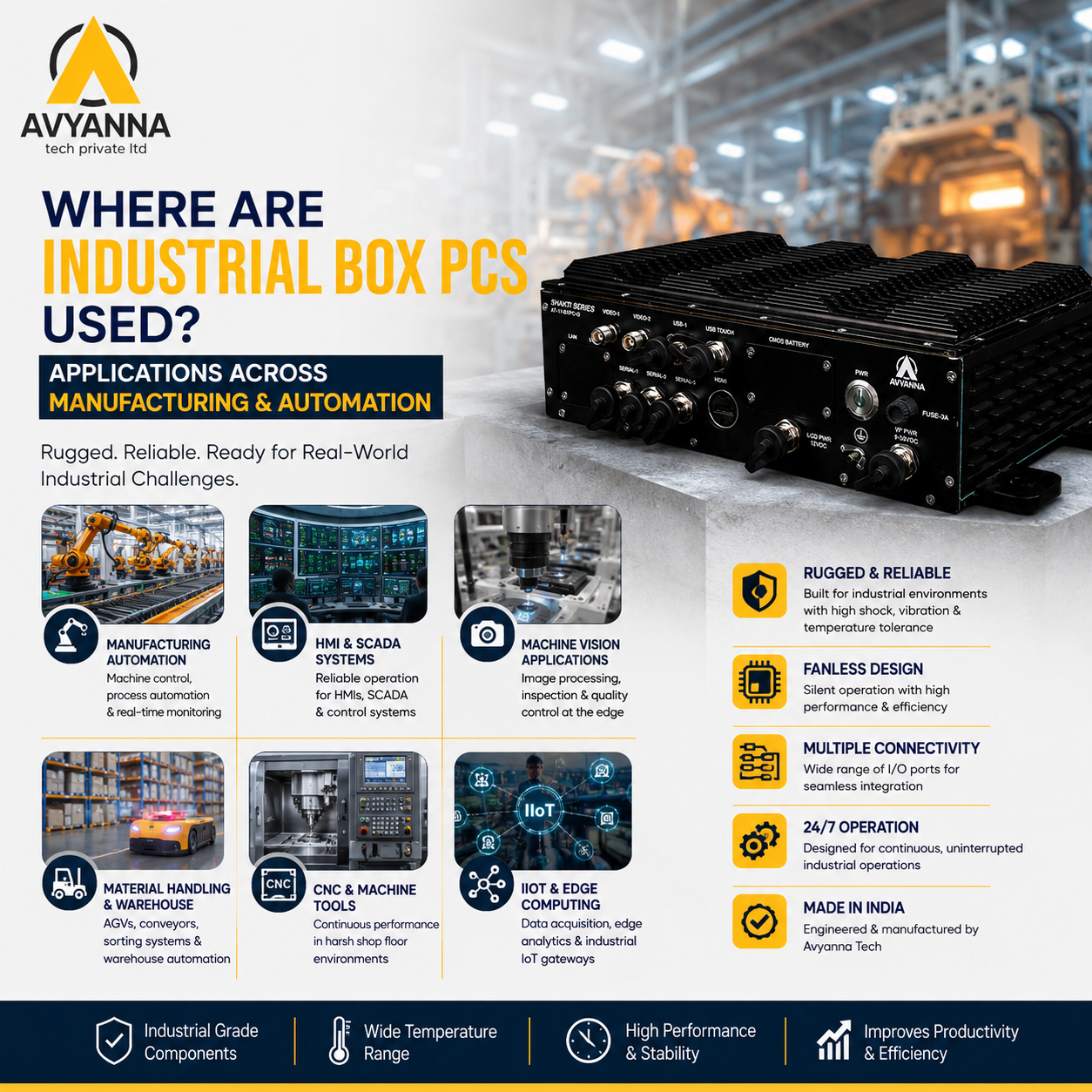
Where Box PCs Are Used Across Manufacturing
A box pc shows up in far more places across a manufacturing facility than most people realize – not just as a generic “industrial computer,” but as the specific processing backbone behind machine vision systems, SCADA backends, kiosks, and vehicle-mounted computing. Understanding where and why a rugged box pc gets deployed helps clarify whether it’s the right hardware choice for a specific automation or monitoring task, rather than treating it as an interchangeable catch-all computer.
Because a box pc is compact, fanless, and built to survive dust, vibration, and continuous operation, it tends to appear anywhere a facility needs reliable computing power without the space, cooling, or environmental compromises of a standard desktop tower. Below is a breakdown of where industrial fanless PC box units are most commonly deployed, and what makes each application a good fit.
Application 1: Machine Vision and Quality Inspection Systems
Machine vision systems – cameras paired with image-processing software that inspect parts for defects, verify assembly, or read barcodes and labels – require continuous, reliable processing directly on or near the production line. A box PC handles this processing load in a compact footprint that mounts near the camera and conveyor, without needing a separate server room connection for every inspection station.
Why a box PC fits: Machine vision runs continuously during production, and any computing downtime halts the inspection process along with it – making the reliability of a fanless, sealed unit directly tied to production uptime.
Application 2: SCADA and HMI Backend Processing
While an operator interacts with a touchscreen HMI display, a box PC often runs the actual SCADA software behind the scenes – collecting data from PLCs, processing alarms, and feeding information to the visible display. Separating the processing unit (box PC) from the display allows more flexible mounting and easier hardware replacement without disturbing the operator-facing screen.
Why a box PC fits: Control room and cabinet space is often limited, and a compact box PC can be mounted separately from the display, simplifying cabinet layout and cable routing.
3. Digital Signage and Unattended Kiosk Systems
Factory floors increasingly use digital signage for production dashboards, safety messaging, or Andon-style status boards, along with self-service kiosks for time clocks or work order lookups. These systems run unattended for extended periods, often 24/7, making hardware reliability critical – a box PC provides the processing power without the maintenance overhead of a fan-cooled system exposed to factory floor dust.
Why a box PC fits: Unattended systems can’t rely on someone noticing and cleaning a clogged fan; fanless, sealed hardware removes that maintenance dependency entirely.
Application 4: Transportation and In-Vehicle Computing
Buses, trains, delivery vehicles, and warehouse forklifts increasingly rely on onboard computing for route management, inventory tracking, or diagnostics – environments defined by constant vibration, temperature swings, and limited space. A rugged box PC, built to tolerate shock and vibration with no moving internal parts, is a natural fit for vehicle-mounted computing where a standard desktop computer would fail quickly.
Why a box PC fits: Vehicle environments combine nearly every environmental stress a box PC is designed for – vibration, temperature extremes, dust, and power fluctuations – making ruggedized, fanless hardware close to a requirement rather than a preference.
Application 5: Warehouse and Logistics Automation
Conveyor control systems, automated storage and retrieval systems (AS/RS), and inventory tracking stations throughout a warehouse rely on continuous computing that can handle dusty, high-traffic environments without frequent maintenance. A box PC mounted near conveyor control panels or sorting stations provides the processing power these systems need in a space-efficient, low-maintenance package.
Why a box PC fits: Warehouse automation systems often run continuously across multiple shifts, and unplanned computer downtime can halt material flow across an entire facility, making reliability the primary selection criterion.
Application 6: Remote and Outdoor Monitoring Stations
Oil, gas, water treatment, and utility monitoring stations are often located outdoors or in remote areas with limited climate control. A box PC rated for extended operating temperatures and sealed against dust and moisture provides reliable data collection and control processing in these environments without requiring a climate-controlled enclosure built around a standard computer.
Why a box PC fits: Remote locations mean maintenance visits are costly and infrequent, making the extended reliability of a fanless, sealed unit especially valuable when on-site troubleshooting isn’t practical.
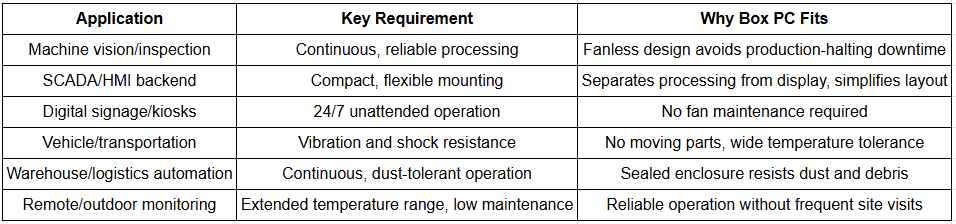
Box PC Applications: Quick Reference
What These Applications Have in Common
Across all six applications, the underlying requirement is the same: computing hardware that keeps running reliably in conditions – dust, vibration, temperature extremes, unattended operation – that would degrade a standard desktop computer within months. This is precisely the gap a rugged box pc is designed to fill, regardless of which specific industry or process it’s supporting.
Choosing a Fanless Box PC Manufacturer for Your Application
Not every fanless box pc manufacturer builds units suited to every application on this list. When evaluating manufacturers for a specific use case, consider:
- Processing power range: Machine vision and analytics-heavy applications need more processing headroom than simple HMI backend or kiosk applications – confirm the manufacturer offers multiple performance tiers.
- Environmental rating options: A manufacturer offering a range of IP ratings and operating temperature specs allows you to match the unit precisely to indoor, outdoor, or vehicle-mounted conditions.
- I/O flexibility: Applications like machine vision often require specific camera interfaces (GigE, USB3 Vision) alongside standard Ethernet and serial ports – confirm the manufacturer’s I/O options match your specific application.
- Mounting and form factor options: Vehicle and warehouse applications often need different mounting hardware than control room or kiosk deployments; a manufacturer with flexible mounting accessories simplifies installation across varied use cases.
- Long-term product availability: Facilities standardizing on one box PC platform across multiple application types benefit from a manufacturer committed to keeping that model available for years of scaling and replacement needs.
Frequently Asked Questions
Where are box PCs commonly used in manufacturing?
PCs are commonly used in machine vision and quality inspection systems, SCADA and HMI backend processing, digital signage and kiosks, warehouse and logistics automation, transportation and in-vehicle computing, and remote or outdoor monitoring stations.
Why use a box PC instead of a standard desktop computer for automation?
A box PC is compact, fanless, and sealed against dust and moisture, making it far more reliable than a standard desktop computer in dusty, vibration-prone, or continuously operating industrial environments where a conventional computer would fail within months.
Can a box PC be used in a moving vehicle?
Yes. A rugged box PC with no moving internal parts and vibration/shock resistance is well-suited for vehicle-mounted computing applications like fleet management, route tracking, and in-vehicle diagnostics, where standard computers would be damaged by constant movement and vibration.
What should I look for in a fanless box PC manufacturer?
Look for a manufacturer offering multiple processing power tiers, a range of environmental (IP) ratings, flexible I/O options suited to your specific application (such as camera interfaces for machine vision), varied mounting options, and long-term product availability commitments.
Is a box PC suitable for outdoor use?
Many industrial box PCs are rated for extended operating temperature ranges and sealed against dust and moisture, making them suitable for outdoor or remote monitoring applications, provided the specific model’s IP rating and temperature range match the installation site’s conditions.
Match the Application to the Right Box PC
From machine vision on the production line to onboard computing in a delivery vehicle, a box pc consistently solves the same underlying problem: reliable processing in conditions that would quickly break a standard computer. Whether your application calls for a compact rugged box pc for a control cabinet or a fully sealed industrial fanless pc box for outdoor deployment, matching the hardware to the specific environment is what determines long-term reliability.
At Avyanna Tech, we help manufacturers and system integrators identify the right box PC for their specific application, from machine vision stations to vehicle-mounted computing. Contact us to explore our full range of fanless box PC solutions and find the right fit for where your automation actually happens.
[email protected]