What to Check Before Buying an RS232 to RS485 Converter for Industrial Use
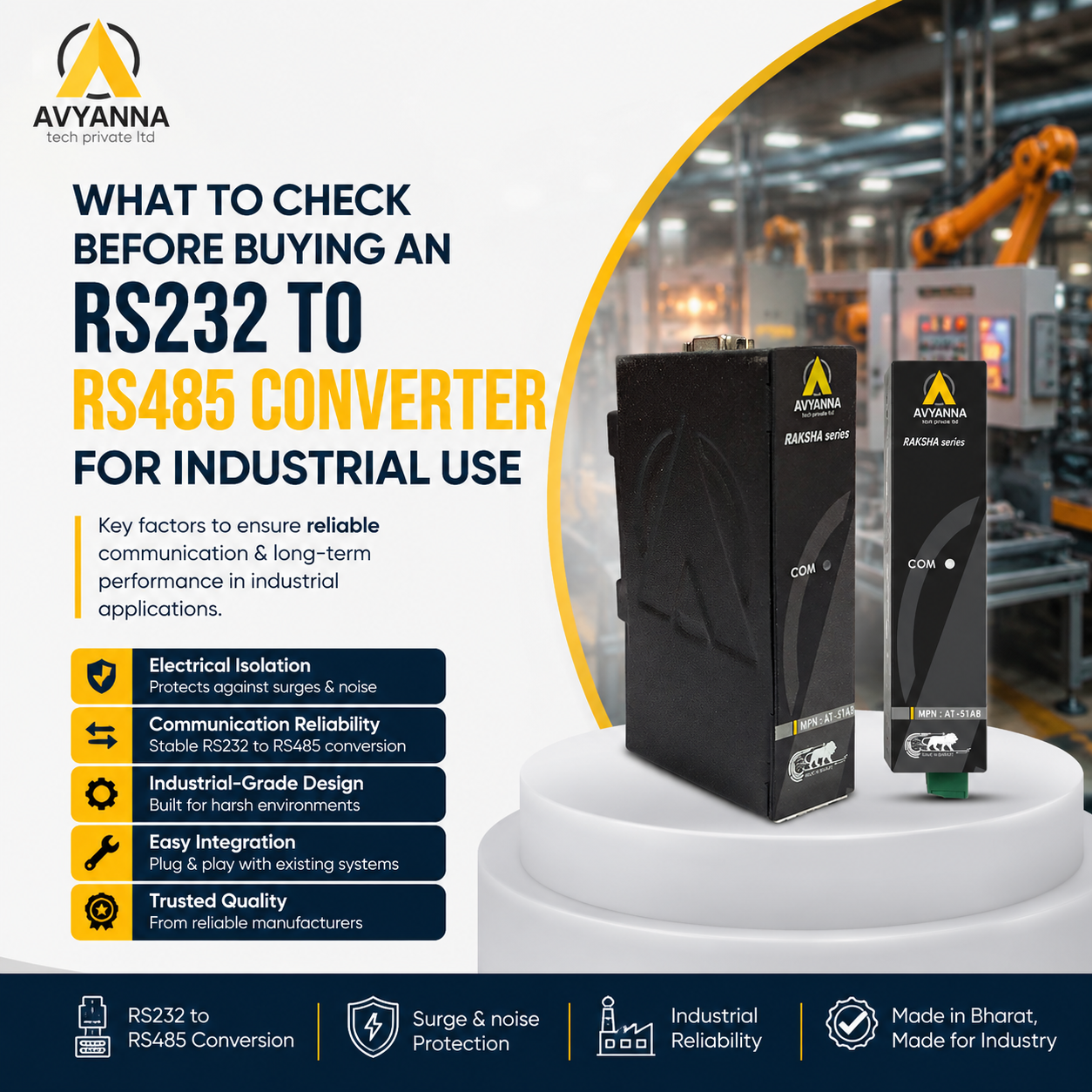
Best RS232 to RS485 Converter: What to Check First
Not every RS232 to RS485 converter on the market is built for industrial conditions, even when the product listing uses industrial-sounding language. Some units are designed for light office or lab use and simply won’t hold up to the electrical noise, temperature swings, or continuous operation found in a typical industrial facility. Buying the wrong converter often means discovering the problem only after installation – when communication errors start appearing or the unit fails outright in conditions it was never rated for.
Before purchasing, there’s a specific set of technical and practical checkpoints worth verifying – isolation rating, baud rate support, certification, and build quality among them – that determine whether a converter will perform reliably in your specific application or become another point of failure on the network.
This checklist walks through exactly what to check before buying an RS232 to RS485 converter for industrial use.
Why Not All RS232 to RS485 Converters Are Built for Industrial Use
Converters marketed broadly for “PC to device” or general connectivity use are often designed around office and lab conditions – stable temperatures, clean power, minimal electrical noise. An industrial facility introduces variables these units were never tested against: voltage fluctuations, nearby motors and VFDs generating electromagnetic interference, dust, and continuous 24/7 operation. Verifying industrial-grade specifications before purchase – rather than assuming any converter will work – is the difference between a reliable long-term installation and a recurring troubleshooting problem.
Checklist: What to Verify Before Buying an RS232 to RS485 Converter
1. Isolation Rating
Check whether the converter offers galvanic isolation, and at what voltage rating (commonly 1,500V to 3,000V). Isolation breaks the shared ground connection between the RS232 and RS485 sides, preventing ground loops and protecting connected equipment from voltage transients. For any installation involving multiple power sources, long cable runs, or nearby heavy machinery, isolation should be treated as a requirement rather than an optional upgrade.
2. Baud Rate Range
Check the full range of baud rates the converter supports, and confirm it covers both your legacy equipment (which may run at lower, older baud rates) and any newer devices on the network. A converter with a narrow supported range can create compatibility gaps that aren’t obvious until installation.
3. Automatic Direction Control
Check whether the converter includes automatic RTS/DTR-based direction switching for RS485 communication. Without this feature, some applications require manual flow control configuration in software, which adds setup complexity and potential for misconfiguration, particularly during retrofits where modifying existing software isn’t practical.
4. Built-In Termination and Biasing
Check whether the converter includes built-in termination resistors and bias networks for the RS485 side. These prevent signal reflection on the bus and keep the line in a known, stable state when idle – without them, installers often need to add external termination components manually, increasing installation complexity and the potential for wiring errors.
5. Operating Temperature Range
Check the manufacturer’s rated operating temperature range against your facility’s actual conditions, including any additional heat from nearby equipment. Industrial-grade converters typically support extended ranges (often -20°C to 60°C or wider), while consumer or office-grade units may be limited to standard indoor ranges.
6. Enclosure and Mounting
Check whether the converter is housed in a metal enclosure suitable for DIN-rail mounting inside a control cabinet, versus a plastic housing designed for a desktop or lab bench. Industrial installations benefit from DIN-rail compatibility for clean, organized cabinet layouts and better protection from physical damage.
7. Surge and Transient Protection
Check for additional transient voltage suppression beyond basic isolation, particularly for installations with outdoor cable runs or exposure to lightning-prone areas. This extra layer of protection reduces the risk of equipment damage from electrical surges that isolation alone may not fully absorb.
8. Certifications
Check for relevant certifications such as CE and FCC, which indicate the converter has been tested for electromagnetic compatibility and safety standards. For specific regulated industries, confirm whether any additional certifications are required before purchase.
9. Power Supply Requirements
Check the converter’s power input requirements against your available power sources – some converters draw power directly from the RS232 port (no external power needed), while others require a separate DC power supply. Confirm compatibility with your installation before purchase to avoid needing additional power infrastructure.
10. Manufacturer Support and Documentation
Check whether the manufacturer provides clear installation documentation, wiring diagrams, and accessible technical support. For industrial deployments that may need troubleshooting months or years after installation, responsive manufacturer support can significantly reduce downtime when issues arise.
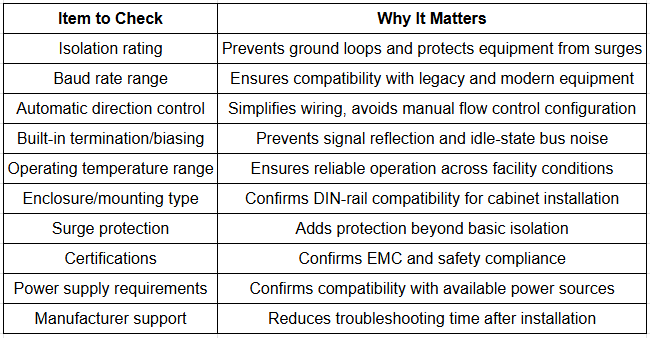
Pre-Purchase Checklist Summary
Red Flags to Watch for When Buying an RS232 to RS485 Converter
- No isolation specification listed – often indicates a non-isolated unit not suited for industrial environments
- Vague or missing operating temperature range – suggests the unit may not be rated for factory floor conditions
- Plastic-only enclosure with no mounting options – typically indicates a desktop/lab-oriented product rather than an industrial one
- No listed certifications – may indicate the unit hasn’t been tested for electromagnetic compatibility or safety standards
- Limited or unclear baud rate specifications – can cause compatibility issues that only surface after installation
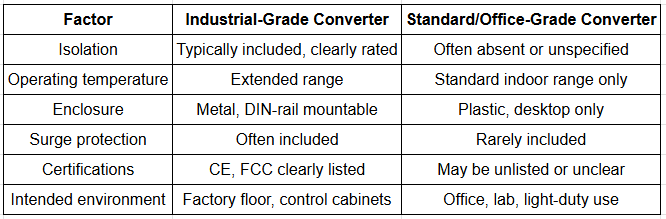
Industrial-Grade vs. Standard RS232 to RS485 Converter: Quick Reference
Frequently Asked Questions
What should I check before buying an RS232 to RS485 converter?
Before buying, check the isolation rating, supported baud rate range, automatic direction control, built-in termination and biasing, operating temperature range, enclosure type and mounting options, surge protection, certifications, power supply requirements, and the manufacturer’s support and documentation.
Do all RS232 to RS485 converters include isolation?
No. Many lower-cost or office-grade converters do not include galvanic isolation, which can leave installations vulnerable to ground loops and electrical noise. Isolation should be specifically verified before purchase, especially for industrial applications.
Why does operating temperature range matter for an RS232 to RS485 converter?
Industrial environments often experience wider temperature swings than office settings, including heat generated by nearby machinery. A converter rated only for standard indoor temperatures may fail or perform unreliably outside that range, making extended temperature ratings important for factory floor installations.
What certifications should an industrial RS232 to RS485 converter have?
Look for CE and FCC certifications at minimum, which confirm the unit has been tested for electromagnetic compatibility and safety standards. Specific regulated industries may require additional certifications depending on the application and region.
Is DIN-rail mounting important for an RS232 to RS485 converter?
For industrial installations, yes. DIN-rail mounting allows the converter to be cleanly integrated into a control cabinet alongside other industrial components, offering better physical protection and organization compared to a desktop-only unit.
Verify Before You Install, Not After
Buying the right RS232 to RS485 converter for industrial use comes down to verifying a specific set of technical checkpoints before purchase – isolation, temperature range, certifications, and build quality among them – rather than assuming any converter labeled “industrial” meets those standards. Taking the time to check these items upfront prevents the far more costly process of diagnosing failures after installation.
At Avyanna Tech, we help engineers and system integrators verify the right specifications and select an RS232 to RS485 converter built for genuine industrial reliability. Contact us to explore our full range of converters and get the checklist right before you install.

[email protected]