
RS232 to RS485 Converter Module: What It Is and How It Works
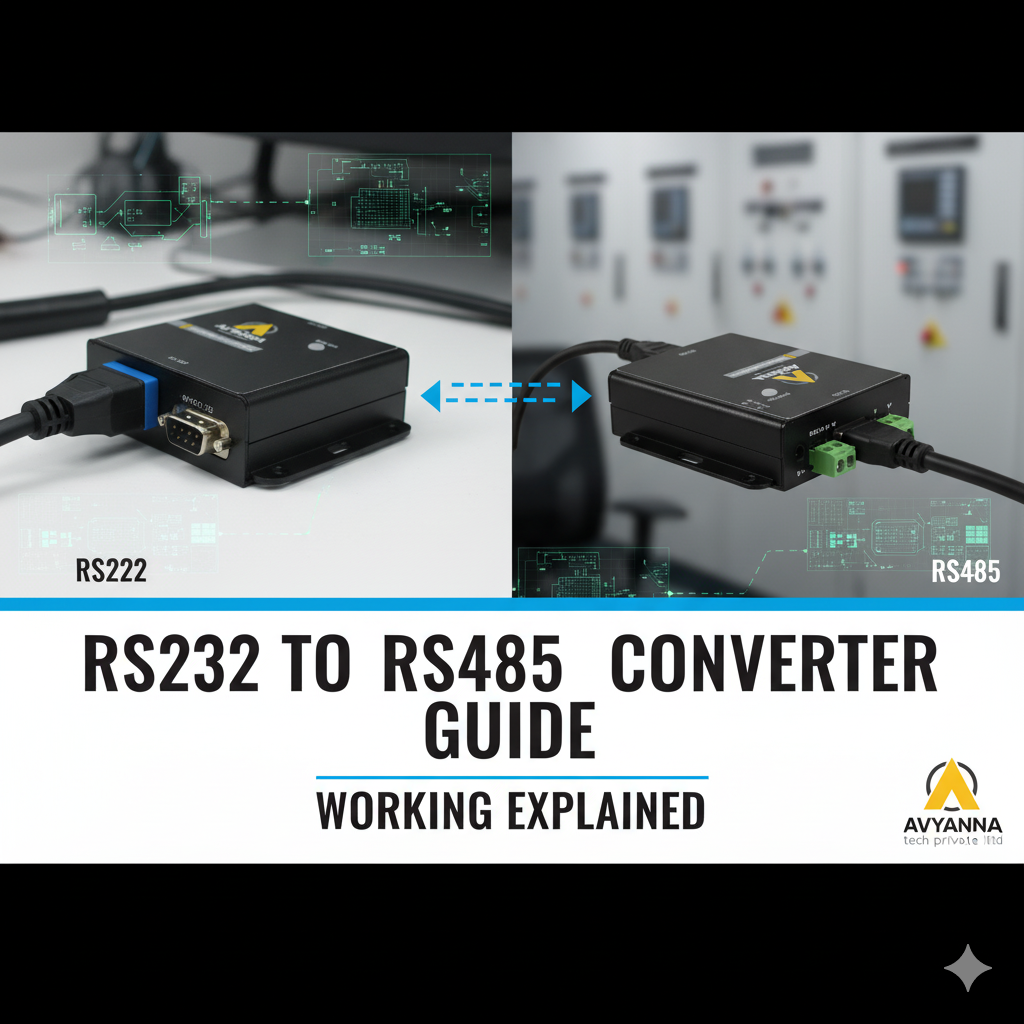
In industrial automation, instrumentation, and control systems, the need to interface devices using different serial communication standards is common. One frequent requirement is converting RS232 signals to RS485. In this article, we’ll break down:
- What a serial port converter is
- Why you might need RS232 → RS485 conversion
- Core components and working principles
- Design choices & trade-offs
- Real-world applications and tips
This is especially relevant if you explore technical solutions like the ones on Avyanna Tech’s site (e.g. their serial port isolator pages) and want clarity without confusion.
1. What Is a Serial Port Converter?
A serial port converter is a device (module, board, or enclosure) that bridges between two different serial communication standards, e.g., RS232 and RS485, allowing devices using one standard to communicate with those using the other.
In our case, an RS232 to RS485 converter lets a device that communicates over RS232 (like many legacy computers, equipment, or controllers) talk to devices on an RS485 bus.
Key benefits:
- Enables longer-distance, multi-node communication (RS485 strengths) from RS232-only systems
- Allows integration of legacy systems with modern bus networks
- Provides robustness (when using isolation, surge protection)
2. Why Convert RS232 to RS485?
To understand the rationale, it helps to contrast the two standards:
| Feature | RS232 | RS485 |
| Topology | Point-to-point (one transmitter, one receiver) | Multi-drop / bus topology: multiple devices on same line |
| Cable distance | Practical limit ~ 15 m (50 ft) | Up to ~1,200 m (≈ 4,000 ft) under proper conditions |
| Noise immunity | Single-ended, more susceptible to interference | Differential (balanced), better noise rejection |
| Number of nodes | Usually single link | Up to 32 or more nodes on a bus (or more with repeaters) |
Because of these differences, converting RS232 to RS485 is useful when you want:
- To extend communication distance
- To network multiple devices on a bus
- To operate in noisy industrial environments
- To modernize systems without redesigning downstream devices
3. How an RS232 to RS485 Converter Works (Core Principles)
Let’s break the internal workings and signal flow in a typical converter:
3.1 Input (RS232) Side
- The converter receives RS232 signals (TX, RX, sometimes RTS/CTS).
- RS232 uses single-ended signaling: a positive or negative voltage relative to ground.
- The converter’s internal circuitry translates this to a logic-level signal (e.g. TTL or CMOS) as an intermediate stage.
3.2 Signal Translation / Logic Stage
- The converter has a transceiver chip or chipset that supports RS485 line interface (driver + receiver).
- Logic circuits interpret when to drive the bus and when to listen.
- Many converters implement automatic direction control (auto-turnaround) so the converter switches between transmit and receive modes transparently (without software).
- Some converters include isolation to decouple grounds, protect against surges or ground loops.
3.3 Output (RS485) Side
- The converter drives a differential pair (commonly labeled A / B or D+ / D−) for RS485.
- In half-duplex mode (the most common for RS485), the same two wires are used both to transmit and receive, but not simultaneously.
- For full-duplex RS485, four wires (A+, A–, B+, B–) may be used, though that’s less common in converter modules.
3.4 Optional Features & Protections
- Termination resistor: a resistor (e.g. 120 Ω) placed across A/B to match line impedance and reduce reflections (often configurable).
- Surge / ESD protection: to guard against voltage spikes, transients, and electrostatic discharge.
- Galvanic isolation: to isolate the RS232 side from the RS485 side, preventing ground loops or high-voltage surges from damaging devices (often rated for kilovolts of isolation).
- Port-powered vs externally powered: some converters draw power from RS232 lines (via signals like RTS, DTR), while others need separate supply (5V, 12V, etc.)
4. Design Variants & Tradeoffs
When designing or choosing an RS232 to RS485 converter, engineers consider tradeoffs across these axes:
- Isolation vs cost: Isolated converters add cost and complexity but offer protection.
- Port-powered vs external power: Port-powered saves wiring but may be limited in drive strength.
- Automatic direction control vs manual: Auto-turnaround is more convenient but may have slight latency.
- Connector types: DB9, DB25, terminal blocks, screw type, board-level headers.
- Environmental ruggedness: Industrial vs consumer grade (temperature, vibration, enclosures)
- Baud rate and speed support: The converter should support your target data rates (e.g. 9600, 115200, etc.).
- Node counts & network length: Some converters support more devices / longer distances.
Example: The CVT-485-1 industrial converter supports port-power operation, auto-turnaround, surge protection, selectable termination, etc.
Another example: Waveshare’s isolated RS232 to RS485/422 converter uses SP3232EEN and SP485EEN chips and supports 300–921,600 bps, isolation, surge protection, and more.
5. Practical Setup & Usage Tips
Here are real-world tips for connecting and deploying RS232 → RS485 converters:
- Wiring: Connect A → A, B → B, and ground (if needed). Ensure solid ground reference if multiple devices.
- Termination: On long lines or high baud rates, enable termination resistors (e.g. 120 Ω) at the ends.
- Biasing / Pull-up & Pull-down: In idle state (no driver), ensure lines have defined state to avoid noise.
- Addressing & Bus Arbitration: In multi-node setups, use addressing in software or hardware (not needed for simple point-to-point).
- Baud & settings match: The devices, converter, and protocol settings (baud, parity, stop bits) must all be consistent.
- Test with loop-back: For verification, loop RX/TX and confirm correct data transfer.
- Ground loops & protection: If devices are far apart, use an isolated converter to avoid ground potential differences.
- Watch for voltage levels: Ensure your RS232 device can supply enough current for the converter if port-powered.
6. Use Cases & Applications
Converters of this kind are widely used in:
- Industrial control and SCADA systems
- Field instrumentation (sensors, meters)
- PLCs, CNC machines
- Building automation (HVAC, lighting control)
- Security / access control systems
- Legacy equipment integration
Because RS485 is robust for long-distance and multipoint systems, converting from RS232 allows older or simpler devices to join modern networks.
7. Conclusion
- A serial port converter is essential when bridging between RS232 and RS485 networks.
- The converter translates single-ended RS232 signals into differential RS485 signals, handling direction control, line driving, and protections.
- Key design decisions include powering method, isolation, direction control, and connector types.
- With proper wiring, termination, and matching settings, RS232 devices can reliably communicate over RS485 buses.
In industrial or noise-prone environments, isolation and surge protection are highly recommended.

[email protected]