
RS232 to RS485 Converter vs Direct Serial Connection: Which Is Better for Industrial Systems?
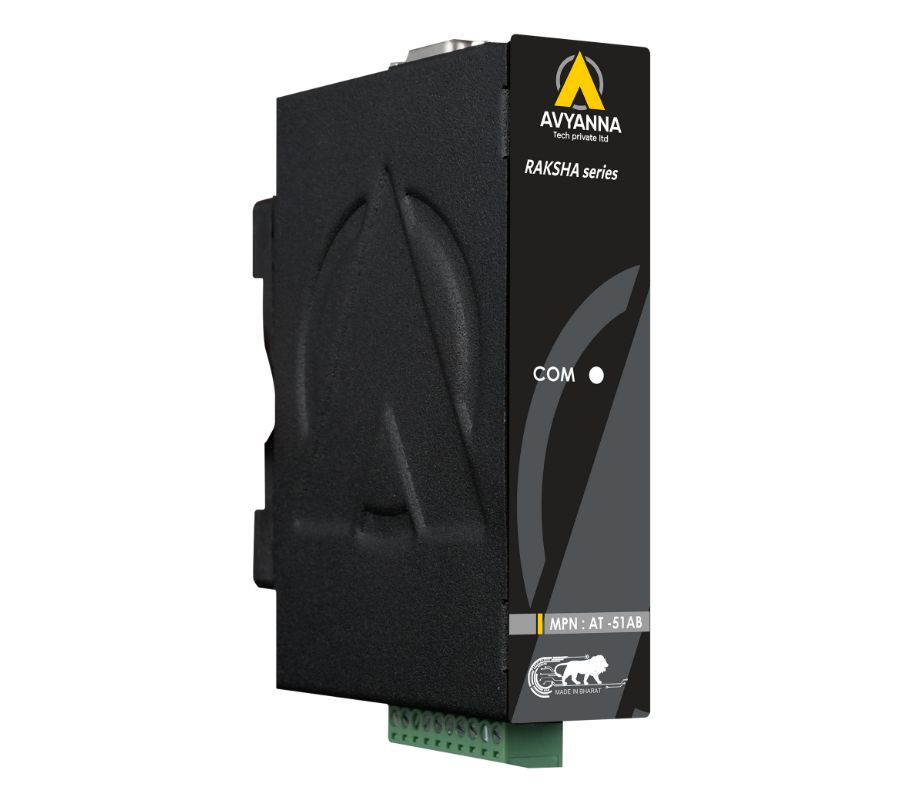
RS232 to RS485 Converter vs Direct Wiring
When two devices in an automation system both support RS232, connecting them with a direct serial cable seems like the simplest option – no additional hardware, no configuration, just a cable between two ports. But that simplicity comes with real limitations, and an RS232 to RS485 converter often ends up being the more practical choice once distance, multiple devices, or electrical noise enter the picture, even in situations where a direct connection would technically work.
The right choice isn’t universal – it depends on cable distance, how many devices need to communicate, and how electrically clean the installation environment actually is. This comparison breaks down exactly when a direct RS232 connection is sufficient and when an industrial RS232 to RS485 converter becomes the better – or only practical – option.
What Does “Direct Serial Connection” Mean in This Comparison?
A direct serial connection refers to wiring two RS232 devices together with a standard point-to-point serial cable, without any protocol conversion or network bridging. This is the simplest possible serial communication setup, historically common for connecting a single PC or controller to a single nearby device.
An RS232 to RS485 converter, by contrast, translates RS232 signaling into RS485’s differential, multi-drop format, enabling longer distances, multiple connected devices, and – with the right converter – electrical isolation from noise and ground loops.
RS232 to RS485 Converter vs. Direct Connection: Key Comparison Points
1. Maximum Cable Distance
A direct RS232 connection is reliably limited to about 15 meters (50 feet) before signal degradation causes communication errors. An RS232 to RS485 converter extends this dramatically – RS485 supports cable runs up to 1,200 meters (4,000 feet) or more. Any application where devices are more than a short distance apart effectively requires a converter, since direct RS232 wiring simply won’t function reliably beyond its short-distance design limit.
2. Number of Connected Devices
A direct serial connection is strictly point-to-point – one device talking to exactly one other device. If your system needs a single controller or PC to communicate with multiple sensors, meters, or instruments, direct RS232 wiring can’t support that topology at all. An RS232 to RS485 converter bridges into RS485’s multi-drop networking, supporting up to 32 devices (or more with repeaters) on a shared bus – making it the only viable option once more than two devices need to communicate on the same line.
3. Noise Immunity
RS232 uses single-ended signaling referenced to a common ground, which offers minimal built-in resistance to electrical noise from nearby motors, variable frequency drives (VFDs), or switching equipment. A direct RS232 connection in an electrically noisy facility is particularly vulnerable to garbled data and intermittent errors. An industrial RS232 to RS485 converter takes advantage of RS485’s differential signaling, which is inherently more resistant to electromagnetic interference (EMI), and – when isolated – further protects against ground loops and voltage transients.
4. Installation Complexity and Cost
A direct serial connection has essentially no additional cost or configuration – it’s simply a cable between two existing RS232 ports. An RS232 to RS485 converter adds hardware cost and a small amount of configuration (baud rate matching, termination settings), representing genuine added complexity for straightforward point-to-point applications where distance and noise aren’t concerns.
5. Scalability for Future Expansion
A direct connection has no path for expansion – adding a third device requires an entirely different wiring approach. An RS232 to RS485 converter, by contrast, is inherently built for a scalable, multi-drop network, meaning additional devices can often be added later without re-architecting the entire communication setup.
6. Equipment and Ground Isolation
Direct RS232 wiring provides no isolation between connected devices – if one device experiences a voltage surge or ground fault, that risk can travel directly to the other connected device. An isolated RS232 to RS485 converter breaks this shared electrical path, protecting both sides from surges, transients, and ground potential differences that a direct connection leaves fully exposed to.
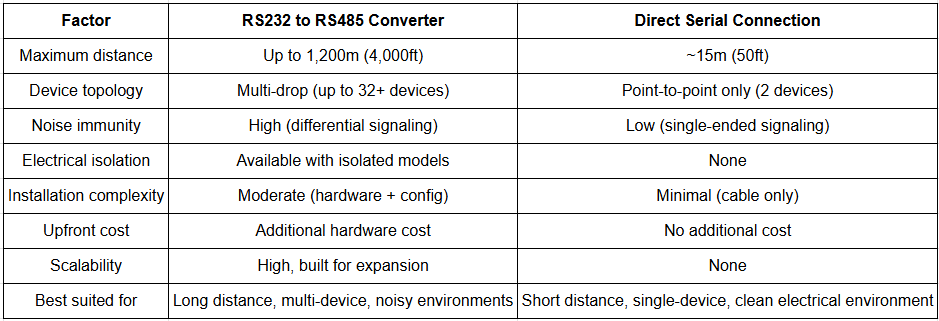
RS232 to RS485 Converter vs. Direct Serial Connection: Comparison Table
When a Direct RS232 Connection Is Still the Right Choice
A direct serial connection remains a reasonable, simpler option when:
- The two devices are within a few meters of each other, well within RS232’s distance limit
- Only two devices ever need to communicate, with no plans for expansion
- The installation is in a clean electrical environment with minimal nearby EMI sources
- Budget and simplicity outweigh the benefits of added distance or noise protection
- The application is temporary, for testing, or otherwise doesn’t justify additional hardware
When an RS232 to RS485 Converter Is the Better Choice
An RS232 to RS485 converter becomes the clearly better – often necessary – option when:
- Devices are separated by more than RS232’s roughly 15-meter limit
- More than two devices need to communicate on the same line
- The installation environment includes motors, VFDs, or other significant EMI sources
- Future expansion to additional devices is anticipated
- Ground isolation is needed to protect equipment from surges or ground loops
- Legacy RS232 equipment needs to integrate into a broader RS485 or networked system
Why Choose an Industrial-Grade RS232 to RS485 Converter Specifically
Not every RS232 to RS485 converter is built for factory floor conditions. An industrial RS232 to RS485 converter specifically adds features that matter in industrial settings but aren’t necessary for office or lab use: galvanic isolation rated for significant voltage differentials, DIN-rail mounting for control cabinet integration, extended operating temperature ranges, and built-in surge protection. Choosing a converter built specifically for industrial use, rather than a general-purpose office-grade unit, ensures the added reliability actually holds up in the environment it’s deployed in.
Frequently Asked Questions
When should I use an RS232 to RS485 converter instead of a direct connection?
Use an RS232 to RS485 converter when devices are separated by more than RS232’s roughly 15-meter distance limit, when more than two devices need to communicate on the same line, when the environment has significant electrical noise, or when future expansion or ground isolation is needed – all situations a direct RS232 connection can’t support.
Is a direct RS232 connection ever better than a converter?
Yes, for simple, short-distance, single-device connections in a clean electrical environment with no expansion plans, a direct RS232 connection avoids the added cost and complexity of a converter without sacrificing reliability.
Can a direct RS232 connection support multiple devices?
No. RS232 is a point-to-point protocol limited to exactly two connected devices. An RS232 to RS485 converter is required to support multi-drop communication with multiple devices on a shared line.
Why is RS485 more resistant to noise than direct RS232 wiring?
RS485 uses differential signaling, where the signal is carried across two wires with noise typically affecting both equally and cancelling out at the receiver, whereas RS232 uses single-ended signaling referenced to a common ground, which offers minimal inherent resistance to electrical noise.
Does an industrial RS232 to RS485 converter cost significantly more than a direct connection?
An industrial RS232 to RS485 converter does add upfront hardware cost compared to a simple cable-only direct connection, but this cost is typically offset by eliminating the distance limitations, noise vulnerability, and lack of scalability that make a direct connection impractical for most industrial applications beyond short, simple setups.
Match the Connection Method to Your System’s Actual Requirements
Choosing between an RS232 to RS485 converter and a direct serial connection comes down to distance, device count, and electrical noise exposure – not simply which option requires less upfront hardware. Short, simple, single-device connections in clean environments may not need a converter, but most industrial applications quickly outgrow direct RS232 wiring’s limitations, making an industrial RS232 to RS485 converter the more reliable long-term choice.
At Avyanna Tech, we help engineers and system integrators determine whether a direct connection or an RS232 to RS485 converter fits their specific distance, device count, and environmental requirements. Contact us to explore our full range of converters and choose the connection method built for how your system actually operates.


[email protected]