
Reduce Serial Communication Errors with an Isolated RS232 to RS485 Converter
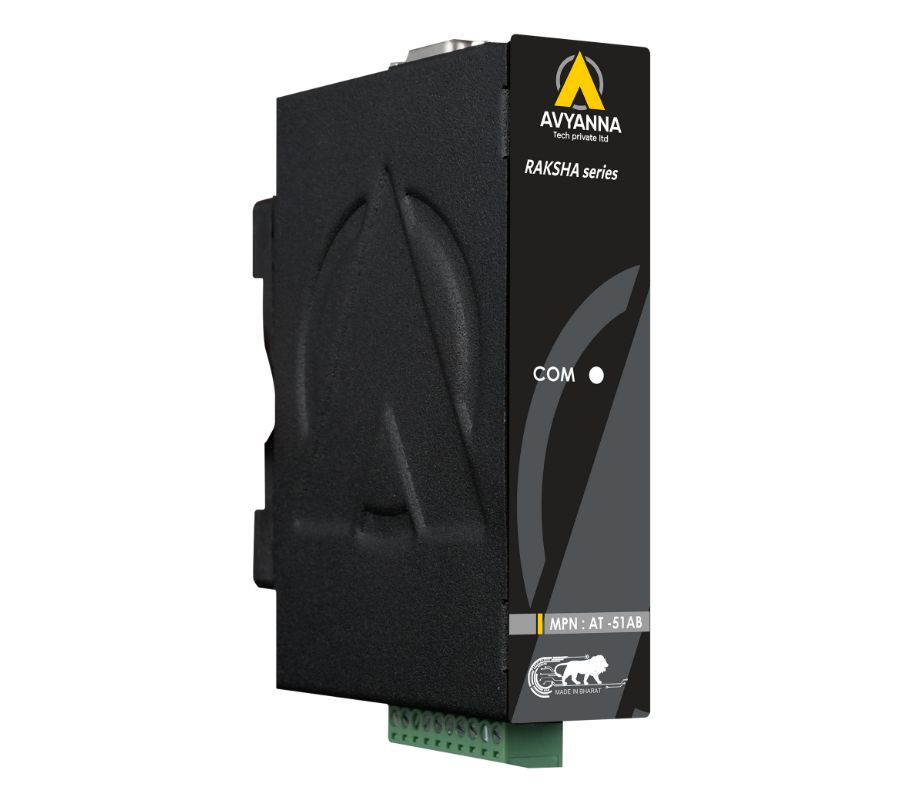
RS232 to RS485 Converter | Reduce Serial Communication Errors
If your PLC, SCADA system, or industrial instrument keeps losing data, freezing mid-transmission, or throwing garbled characters on a serial link, the root cause is often electrical, not software. A well-engineered RS232 to RS485 converter – particularly one with galvanic isolation – solves this by extending communication distance, rejecting electrical noise, and breaking the ground loops that corrupt data on long industrial cable runs. In this guide, we’ll look at why these errors happen, how isolation fixes them, and what to look for when choosing a converter for your plant floor.
Why Serial Communication Errors Happen in Industrial Environments
RS232 was never designed for factory floors. It’s a point-to-point standard, rated for cable runs of roughly 15 meters (50 feet) and vulnerable to electrical interference. When you connect an RS232 device across a plant using long cable runs near VFDs, motors, welding equipment, or high-voltage switchgear, several problems commonly appear:
- Signal attenuation over distance, causing bit errors and dropped characters
- Electromagnetic interference (EMI) from motors, contactors, and variable frequency drives
- Ground potential differences between equipment on separate power circuits, creating ground loops
- Voltage spikes and surges from lightning strikes or switching transients that can damage sensitive port circuitry
- Limited multi-drop capability, since RS232 only supports one device per port
RS485, by contrast, uses differential signaling, which makes it inherently more resistant to noise and capable of reliable communication over distances up to 1200 meters (4000 feet), while also supporting multi-drop networks of up to 32 devices on a single bus. Converting between the two lets you keep legacy RS232 equipment (PLCs, HMIs, sensors, meters, PC serial ports) while gaining RS485’s industrial-grade robustness.
What Is an RS232 to RS485 Converter?
An RS232 to RS485 converter is a hardware interface device that translates single-ended RS232 signaling into differential RS485 signaling (and back again), allowing serial devices built for short point-to-point connections to communicate reliably over long-distance, multi-drop industrial networks.
It typically handles:
- Voltage-level translation between RS232’s ±12V single-ended signals and RS485’s balanced differential pair
- Automatic direction control (RTS/DE handling) for half-duplex RS485 networks
- Baud rate matching, usually auto-sensing from 300 bps up to 115200 bps or higher
- Termination and biasing to prevent reflection errors on long cable runs
Why Isolation Matters: The Missing Piece Most Converters Skip
A standard converter solves distance and multi-drop problems, but it doesn’t solve the electrical problems – and this is where most serial communication errors actually originate on real installations.
An isolated RS232 to RS485 converter adds galvanic isolation (commonly 2kV to 4kV) between the RS232 side, the RS485 side, and sometimes the power input, using optocouplers or isolated DC-DC converters internally. This isolation barrier:
- Breaks ground loops by eliminating the shared electrical path between devices powered from different grounds or substations
- Blocks surge and transient energy from reaching connected equipment during lightning events or switching spikes
- Protects expensive control systems – PLCs, DCS controllers, and SCADA gateways – from damage caused by voltage differentials
- Improves noise immunity in electrically noisy environments like substations, motor control centers, and welding bays
Without isolation, ground loops alone are one of the most common – and most misdiagnosed – causes of intermittent serial errors, since they don’t show up as a hard failure but as random, hard-to-reproduce data corruption.
Isolated vs. Non-Isolated Converters: Quick Comparison
| Feature | Non-Isolated Converter | Isolated RS232 to RS485 Converter |
| Ground loop protection | No | Yes |
| Surge/transient protection | Minimal | Yes (typically 2kV–4kV) |
| Suitable for noisy environments | Limited | Yes |
| Long-distance reliability | Moderate | High |
| Recommended for outdoor/field wiring | Not recommended | Recommended |
| Equipment protection | Basic | High |
Common Applications for Isolated RS232 to RS485 Converters
- Industrial automation: Connecting legacy RS232 PLCs or HMIs to RS485-based plant networks
- Building management systems (BMS): Linking sensors and controllers across floors with differing ground references
- Energy and utilities: Interfacing meters, RTUs, and protection relays in substations with high EMI
- Water and wastewater plants: Long cable runs between remote pump stations and central SCADA
- Manufacturing lines: Bridging older CNC or barcode scanner equipment to modern fieldbus networks
How to Choose the Right RS232 to RS485 Converter
When evaluating converters for a project, check these specifications against your environment:
- Isolation voltage rating – 2kV minimum for industrial settings; 4kV for high-EMI or outdoor installations
- Baud rate range and auto-detection – ensure it matches your device’s communication settings
- Half-duplex vs. full-duplex support and automatic RTS/DE switching, so you don’t need manual flow-control jumpers
- Built-in termination and bias resistors, switchable for multi-drop bus configurations
- DIN-rail or panel mounting for clean integration into control cabinets
- Operating temperature range, particularly for outdoor enclosures or unconditioned plant rooms
- Surge protection rating on both data and power lines
People Also Ask
Can RS232 be converted to RS485?
Yes. A dedicated RS232 to RS485 converter translates RS232’s single-ended signaling into RS485’s differential format, enabling longer cable runs, multi-drop networks, and better noise resistance than RS232 alone can provide.
Why do I need isolation on a serial converter?
Isolation prevents ground loops and blocks voltage surges from passing between connected devices. Without it, equipment on different ground references can develop damaging potential differences that cause data corruption or hardware failure.
What is the maximum distance for RS485 communication?
RS485 can reliably communicate over cable runs of up to 1200 meters (about 4000 feet), far exceeding RS232’s practical limit of roughly 15 meters.
Does an RS232 to RS485 converter need external power?
Most isolated converters require a separate DC power supply (commonly 9–24V) to power the isolation circuitry, while some non-isolated, low-speed converters can draw power directly from the RS232 port.
What causes intermittent serial communication errors?
The most frequent causes are electrical noise from nearby motors or VFDs, ground potential differences between devices, cable runs exceeding RS232’s limits, and lack of proper termination on RS485 multi-drop networks – all of which an isolated converter is designed to address.
Conclusion
Serial communication errors on industrial networks are rarely random – they’re almost always traceable to distance limitations, electrical noise, or ground loops that standard RS232 wiring simply isn’t built to handle. Deploying an isolated RS232 to RS485 converter addresses all three at once: it extends your usable cable distance, enables multi-drop connectivity, and – critically – uses galvanic isolation to protect your equipment and keep data clean even in electrically hostile environments.
If you’re specifying a converter for a new installation or troubleshooting a network with recurring dropouts, Contact us to explore Avyanna Tech‘s range of industrial data converters, including isolated RS232 to RS485 models built for demanding automation environments.
[email protected]